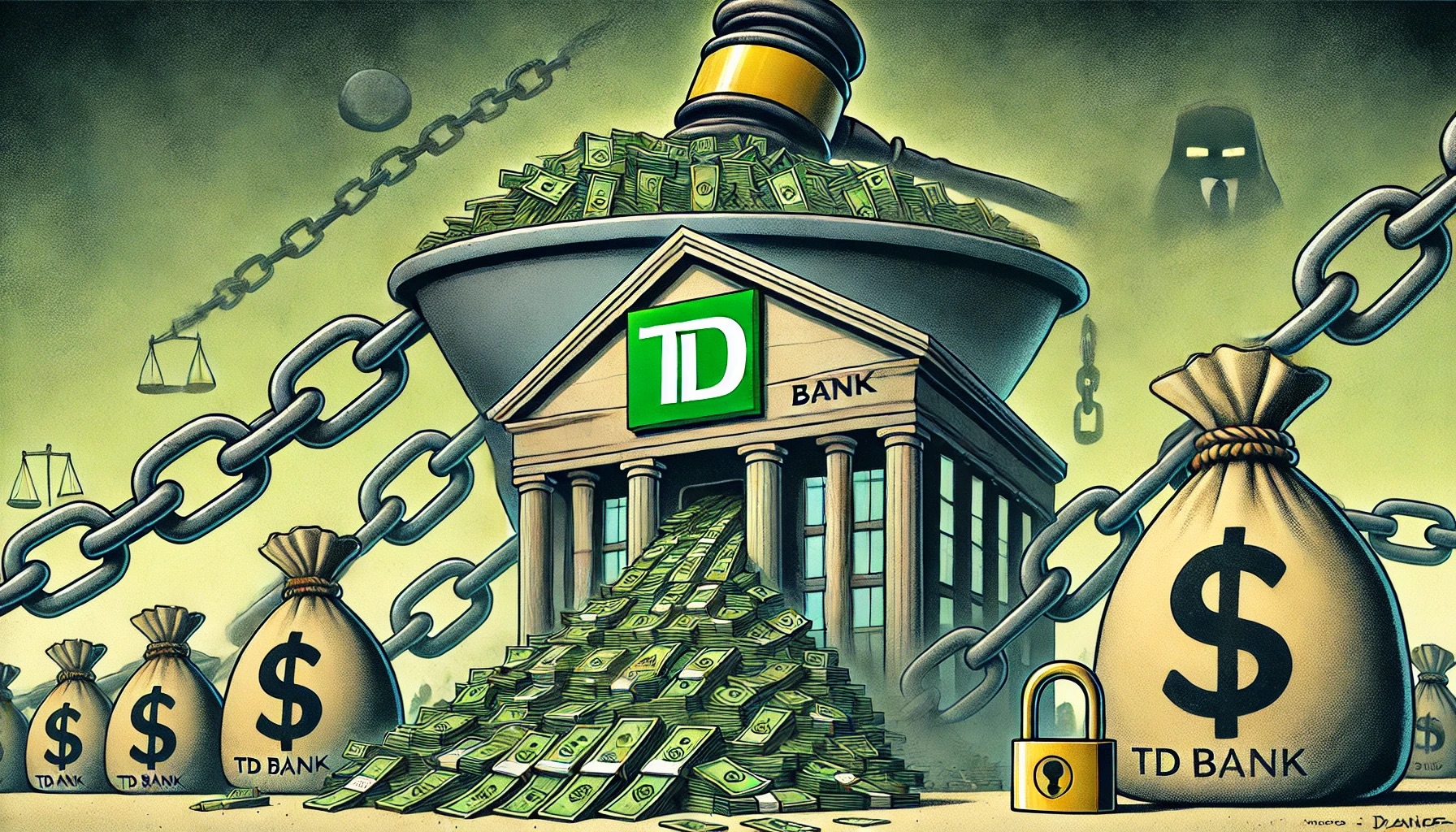
TD Bank has admitted to violating U.S. anti-money laundering laws, pleading guilty to conspiring to launder money and failing to file accurate reports. The bank will pay $3 billion in penalties and face an asset cap, significantly limiting its growth in the U.S. market.
TD Bank Agrees to Pay $3 Billion in Penalties, Faces Asset Cap After Money Laundering Guilty Plea
According to government officials, on October 10, TD Bank became the largest bank in the United States to plead guilty to violating a federal law designed to prevent money laundering. In exchange for resolving the charges, the bank agreed to pay $3 billion in penalties.
Authorities have stated that TD's plea agreement includes imposing an asset cap and other restrictions on its business. According to the Justice Department, the bank has entered a plea of guilty to conspiring to launder money and conspiring to fail to file accurate reports or maintain a compliant anti-money laundering program.
U.S. authorities have described the issues as pervasive. According to Reuters, they state that TD neglected to monitor over $18 trillion in customer activity for approximately a decade, which allowed three money laundering networks to transfer illicit funds through the bank's accounts.
During a briefing on the plea agreement, Attorney General Merrick Garland disclosed that bank employees "openly joked" on numerous occasions about the lack of compliance.
"TD Bank chose profits over compliance in order to keep its costs down," Garland said. He said TD was the largest bank to admit to violating the U.S. Bank Secrecy Act.
Authorities stated that TD only identified suspicious activity in certain instances once law enforcement drew attention to it.
TD Bank Faces Asset Cap and Restrictions Amid $3 Billion Settlement, Hindering U.S. Expansion Efforts
The Office of the Comptroller of the Currency's asset limit is a rare measure typically reserved for severe cases. It is a significant setback for TD, which has been striving to increase its presence in the United States, a market that generates approximately one-third of the bank's revenue.
Regulators also stated that the agreement prevents TD Bank from establishing a new branch or entering a new market without the OCC's approval.
The Justice Department, U.S. banking regulators, and the Treasury Department's Financial Crimes Enforcement Network will receive a combined $3 billion in penalties.
The agreement concludes investigations conducted by the Justice Department, the Office of the Comptroller of the Currency, and the Financial Crimes Enforcement Network of the Treasury. It also encompasses the implementation of independent monitoring.
TD Bank Faces Asset Cap, CEO Retirement Amid Money Laundering Scandal and Stock Underperformance
Lemar Persaud, an analyst at Cormark Securities, stated that an asset cap was the "worst-case scenario" for TD before the plea agreement was disclosed. For the punishment, the bank has already allocated $3 billion.
Persaud compared Wells Fargo, which has a $1.95 trillion asset limit in place due to a fake accounts scandal, which has restricted its earnings. He also stated that an asset limit would restrict TD's profits, although to a lesser extent than it did for Wells Fargo.
Persaud stated that the TD probe has resulted in "substantial underperformance of the stock" and, in his opinion, "the retirement of the current CEO, Bharat Masrani."
TD is Canada's second-largest bank and the United States's tenth-largest bank. Last year, barely a few months after terminating a $13 billion acquisition of regional lender First Horizon, the lender initially disclosed that it was responding to regulators and law enforcement inquiries.
Federal authorities initiated an investigation into TD's internal controls after agents discovered a Chinese criminal operation that bribed employees and transported large sacks of cash into branches to launder millions of dollars in fentanyl sales through TD branches in New York and New Jersey, according to a source.
To distance itself from the money laundering scandal, TD has spent millions to enhance its compliance programs, terminated dozens of employees at its U.S. branches, and appointed Ray Chun, the director of personal banking in Canada, as its new CEO.
Masrani, who has been CEO for nearly a decade and previously headed its U.S. operations, will retire next year. He has acknowledged that he is entirely accountable for the money laundering issues that have beset the bank.