
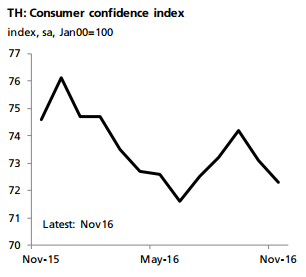
Private consumption in Thailand is expected to be stuck in the 3-3.5 percent range for a lot longer than most expect. The recent slide in the consumer confidence index is another sign that households remain cautious going into 2017.
It is tough to see private consumption growth back to its 4 percent potential. Nominal wage growth has slipped back to sub-1 percent in 4Q16, compared to an average of 2 percent in the first three-quarters of the year. Given that inflation has already returned to the positive, this means that real wage growth is flat going into 2017. Until we get stronger investment / export growth, weak wage growth is likely to persist, DBS reported.
At the very least, however, consumption growth is no longer falling. Positive spillovers from the government’s pump-priming are likely to pull up consumption demand, particularly in the rural areas. Besides, the slight recovery in the agriculture sector should also help.
Meanwhile, the sector grew 1 percent y/y in 3Q16, a modest turnaround after contracting by 1.3 percent and 3.8 percent in 1H16 and 2015 respectively. If sustained, even a marginal 1 percent growth in the agriculture sector may make a decent difference, noting that the sector employs one-third of the labor force, the report added.

