Humans have been riding bicycle-like machines for close to 200 years, beginning with the Draisine or “velocipede” in 1817.
While riding and balancing a bicycle can seem simple and effortless, the actual control process used by a human rider is still somewhat of a mystery. Using mathematical equations, researchers have explained how a bicycle without a rider can balance itself and have identified the bicycle design features critical for that to happen.
However, the stability – that is, the ability to remain balanced – of a bicycle with a rider is more difficult to quantify and describe mathematically, especially since rider ability can vary widely. My colleagues and I brought expert and novice riders into the lab to investigate whether they use different balancing techniques.
The physics of staying upright on a bicycle
A big part of balancing a bicycle has to do with controlling the center of mass of the rider-bicycle system. The center of mass is the point at which all the mass (person plus bicycle) can be considered to be concentrated. During straight riding, the rider must always keep that center of mass over the wheels, or what’s called the base of support – an imaginary polygon that connects the two tire contacts with the ground.
Bicycle riders can use two main balancing strategies: steering and body movement relative to the bike. Steering is critical for maintaining balance and allows the bicycle to move to bring the base of support back under the center of mass. Imagine balancing a broomstick on one hand – steering a bicycle is equivalent to the hand motions required to keep the broomstick balanced. Steering input can be provided by the rider directly via handlebars (steering torque) or through the self-stability of the bicycle, which arises because the steer and roll of a bicycle are coupled; a bicycle leaned to its side (roll) will cause a change in its steer angle.
Body movements relative to the bicycle – like leaning left and right – have a smaller effect than steering, but allow a rider to make balance corrections by shifting the center of mass side to side relative to the bicycle and base of support.
Steering is absolutely necessary to balance a bicycle, whereas body movements are not; there is no specific combination of the two to ensure balance. The basic strategy to balance a bicycle, as noted by Karl von Drais (inventor of the Draisine), is to steer into the undesired fall.
Newbies versus pros
While riders have been described using mathematical equations, the equations are not yet useful for understanding the differences between riders of different ability levels or for predicting the stability of a given rider on a given bicycle.
Therefore, the goal of my colleagues' and my recent work was to explore the types of control used by both novice and expert riders and to identify the differences between the two groups. In our study, expert riders identified themselves as skilled cyclists, went on regular training rides, belonged to a cycling club or team, competed several times per year, and had used rollers for training indoors. Novice riders knew how to ride a bicycle but did so only occasionally for recreation or transportation and did not identify themselves as experts.

A subject riding the instrumented bicycle on training rollers in our experimental setup. Cain SM, Ashton-Miller JA, Perkins NC (2016) On the Skill of Balancing While Riding a Bicycle. PLoS ONE 11(2): e0149340, CC BY
We conducted our experiments in a motion capture laboratory, where the riders rode a typical mountain bike on rollers. Rollers constrain the bicycle in the fore-aft direction but allow free lateral (left-right) movement. They require a bicycle rider to maintain balance by pedaling, steering and leaning, as one would outdoors.

A subject preparing to ride the instrumented bicycle in our experimental setup. Stephen Cain, CC BY-ND
We mounted sensors and used a motion capture system to measure the motion of the bicycle (speed, steering angle and rate, roll angle and rate) and the steering torque used by the rider. A force platform underneath the rollers allowed us to calculate the lateral position of the center of mass relative to the base of support; that let us determine how a rider was leaning.
We found that both novice and expert riders exhibit similar balance performance at slow speeds. But at higher speeds, expert riders achieve superior balance performance by employing smaller but more effective body movements and less steering. Regardless of speed, expert riders use smaller and less varying steering inputs and less body movement variation.
We conclude that expert riders are able to use body movements more effectively than novice riders, which results in reducing the demand for both large corrective steering and body movements.
Mysteries remain
Despite our work and that of others in the field, there is still much to be learned about how humans ride and balance bicycles. Most research, including ours, has been limited to straight line riding, which only makes up a fraction of a typical bicycle ride.

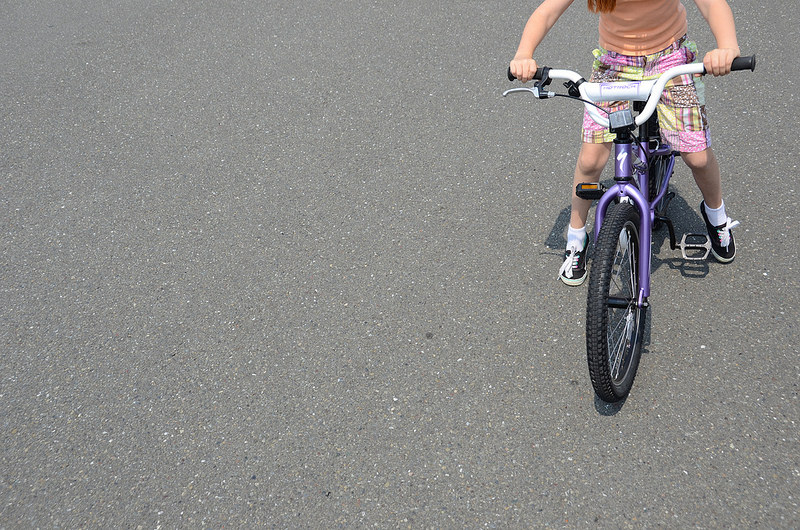
Out in the world, expert riders know how to control the bike with subtle movements. Bureau of Land Management Oregon and Washington, CC BY
Our work reveals measurable differences between riders of different skill levels. But their meaning is unclear. Are the differences linked to a higher risk of crashing for the novice riders? Or do the differences simply reflect a different style of control that gets fine-tuned through hours and hours of training rides?
Ideally, we would like to identify the measurements that quantify the balance performance, control strategy and fall risk of a rider in the real world.
With such measurements, we could identify riders at high risk of falling, explore the extent to which bicycle design can reduce fall risk and increase balance performance, and develop the mathematical equations that describe riders of different skill levels.
 Stephen Cain receives funding from the National Science Foundation and the U.S. Army Natick Soldier Research, Development & Engineering Center.
Stephen Cain, Research Investigator in Department of Mechanical Engineering, University of Michigan
This article was originally published on The Conversation. Read the original article.