
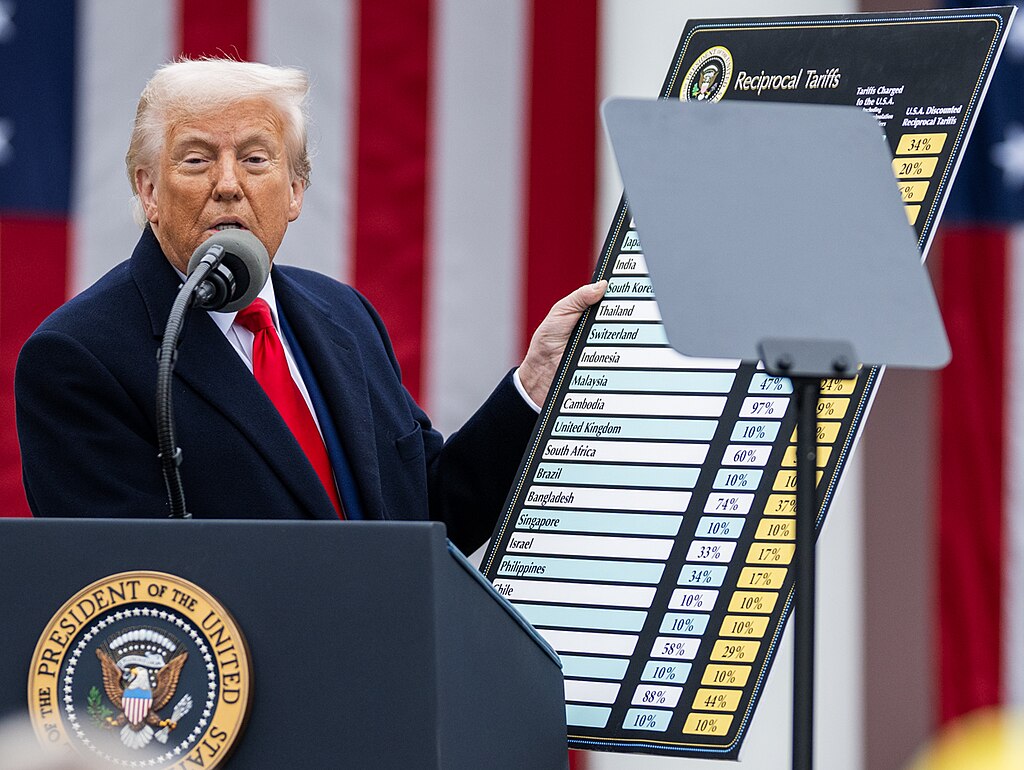
U.S. President Donald Trump said Wednesday that America’s trade deficit has narrowed significantly due to his 2025 trade tariffs, adding that the country could post its first trade surplus in decades as early as this year. In a social media statement, Trump claimed the U.S. trade deficit “has been reduced by 78% because of the tariffs being charged to other companies and countries,” though he did not clarify the specific timeframe behind the figure.
Recent government data shows the U.S. goods and services trade deficit dropped to $27.62 billion in October 2025, down from a record $140.5 billion in March 2025—an approximately 80% decline, based on Investing.com calculations. However, the deficit widened again to $56.82 billion in November, highlighting ongoing volatility in U.S. trade data.
Official December trade figures, due Thursday, are projected to show a $55.50 billion trade surplus. If confirmed, it would mark the first positive monthly trade balance for the United States since 1975. Trump also stated that the trade balance “will go into positive territory during this year,” reinforcing expectations of improved trade performance heading into 2026.
Despite recent improvements, the U.S. is still forecast to record a trade deficit exceeding $800 billion in 2025, compared with a record $1.2 trillion shortfall in 2024. Much of this year’s imbalance stemmed from a surge in imports during the first quarter, when businesses stockpiled goods ahead of Trump’s so-called “liberation day” tariffs introduced in April.
The goods trade deficit remains near historic highs at roughly $1.2 trillion. While tariffs ranging from 10% to 50% curbed imports—particularly from China, where shipments fell to $288 billion from $401 billion year-over-year—rising imports from other Asian and European nations partially offset those declines.


