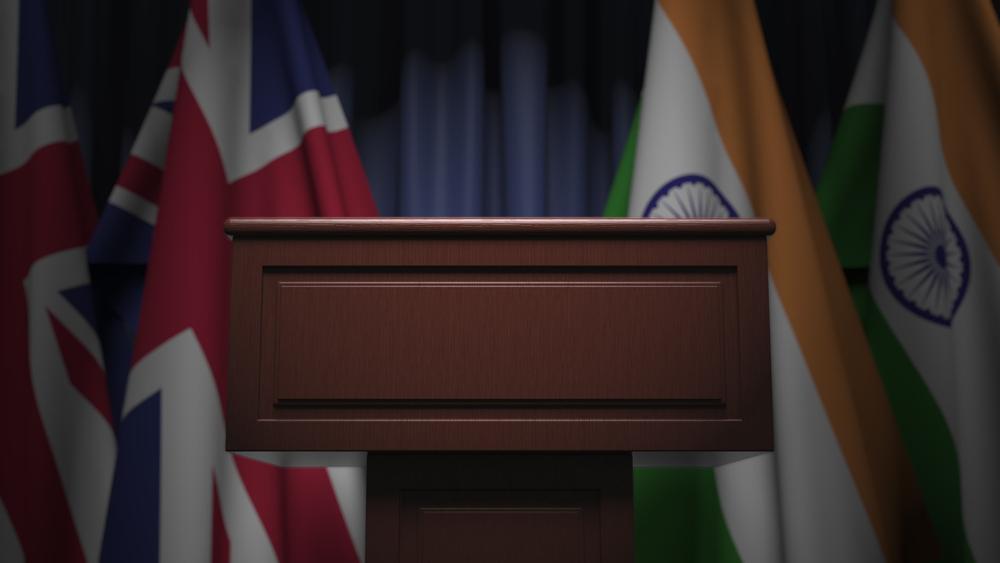
The UK and India have announced a new enhanced deal on trade at a virtual summit. The deal aims to double trade between the two countries by 2030 and declares their joint commitment to start working towards a comprehensive free-trade agreement, for which discussions are due to commence in the autumn.
Britain and India announced £1 billion of new trade and investment as part of this new Enhanced Trade Partnership. Indian investments worth £533 million will be made in Britain, including £240 million by the Serum Institute for production of Oxford-AstraZeneca vaccines and sales business. At the same time, £446 million worth of export deals were announced by British businesses in India. This builds on a trade relationship that was already worth £25.5 billion in 2019.
At the summit the UK prime minister, Boris Johnson, and his Indian counterpart, Narendra Modi, also launched a Roadmap 2030 to expand and deepen bilateral cooperation in five areas: people-to-people relationships, trade and prosperity, defence and security, climate action and healthcare cooperation.
Deeper ties
The new deal is expected to generate additional employment in both countries, grow bilateral trade and unlock new opportunities in sectors such as food and drink, business services such as law and accounting, advanced engineering, defence, education, energy, life sciences and healthcare. It will also reduce barriers, both tariff and non-tariff, for businesses at a time when the prospects for global growth after the COVID-19 pandemic remain uncertain.
The deal is particularly interesting due to its size and intended scope. The UK and India are the 5th and 6th biggest economies in the world. India is the largest single market, of about 1.4 billion people, that the UK has committed to negotiating a free-trade deal with to date.
India is Britain’s sixth-largest non-EU trading partner, whereas Britain is barely inside India’s top 20. This points to significant scope for growth on both sides. Once agreed, the free-trade deal is likely to be extremely significant, fostering innovation and technology cooperation as well as skills transfer and knowledge-sharing between the two nations.
At present, however, India is facing a particularly devastating health threat following the latest outbreak of COVID-19. The UK government and the diaspora have been supporting India with things like ventilators, oxygen generation units and a clinical advisory group, but the subcontinent is so large and populous that there is only so much that can be achieved.
The new agreement can potentially help by easing the pain of economic contraction for India in 2021, while supporting both partners as they commence rebuilding efforts to recover from the pandemic.
Britain and the Indo-Pacific
The deal will likely strengthen the geopolitical positions of both nations in a part of the world that is dominated by China. The UK’s recent Integrated Review of Security, Defence, Development and Foreign Policy articulated the importance of an Indo-Pacific region with “open societies”.
The UK signalled a willingness in the review to play a larger role in the region, committing to a larger naval presence to ensure freedom of navigation. It has applied to join the Comprehensive and Progressive Agreement for Trans-Pacific Partnership (CPTPP), a free-trade bloc of 11 Pacific nations including Japan, Australia and Canada.
The UK has also become an official dialogue partner of the ten-member Association of Southeast Asian Nations (ASEAN), which includes Indonesia, Malaysia, Singapore and Vietnam. All this, including the trade deal with India, seeks to help the UK to “unlock opportunities in the region” and establish an outward-looking global Britain.
Finally, announcing an UK-India agreement before the EU-India summit on May 8 gives the UK a first-mover advantage over the trading bloc that it has just left behind. In keeping with the UK-India deal, facilitating investment, regulatory cooperation and trade barriers are at the top of the agenda at the summit. The EU is also seeking to make progress on a free-trade agreement, as well as several other treaties on specific aspects of trade. Modi had been due to visit Porto, Portugal for the occasion, but this has been cancelled due to the pandemic.
The UK-India declaration for an Enhanced Trade Partnership symbolises the commitment of both countries to bolster what Modi has referred to as “living bridge” between the two countries in light of their shared history, culture and democratic values. It is these common attributes – together with complementary skills and capabilities – that make the UK and Indian natural partners despite the geographical distance, especially at a time when both the economies will have to address the economic rebuilding agenda after the pandemic.