


 Italy’s Meloni Warns US-Russia Diesel Deal Could Weaken Ukraine Sanctions
  Zelenskiy Seeks New US Talks to Revive Ukraine-Russia Peace Negotiations
  US Senate Midterms 2026: Key Races That Could Flip Control
  Elon Musk Donates $366 Million to 2026 US Midterms
  Zelenskiy Says Ukraine Received No Warning Before Russian Missile Attack
  Netanyahu Rejects Preemptive Iran Strike Ahead of Israel Election
  MI5 Warns of Rising Iran, Russia Threats and AI Bioweapon Risks
  China Warns Taiwan Over South China Sea Coast Guard Incident
  Gaza Olive Harvest Collapses as War Destroys Farmland
  US Condemns China Sanctions on Taiwan Allies Belize and Paraguay
  Trump Denies China, Russia Are Helping Iran in War
  Trump Warns Houthis Over Attacks, Considers Erdogan Intervention
  Zelenskiy Says Trump’s Support for Russia Is ‘Painful’
  FBI Denies Report of Kash Patel’s Russia Visit
  IMF Warns US Debt Crisis Needs Fiscal Action, Urges China to Boost Consumption
  Container Ship Sinks in Strait of Hormuz as Iran Attacks Escalate
  Trump Announces Massive Oil and Mineral Exploration Plans in Greenland


 Add as a preferred source on Google

A wide range of US election polls are leaning solidly toward a Joe Biden victory. But Donald Trump and his supporters claim to be certain of his victory on November 3, and it’s not without historical precedent. In 2016, the polls favored Hillary Clinton and on election night she garnered 3 million more votes than Trump. But she didn’t make it to the White House because of the Electoral College, or so the argument goes. In fact, the real problem is elsewhere.
False problem: the Electoral College
The US Electoral College gives each state the same number of electors as the state has members of Congress. With the exception of voters in Nebraska and Maine, Americans choose their president using majority voting: voters mark a box next to the name of a candidate, and the candidate with the greatest number of boxes marked wins all the state’s electoral votes, regardless the margin of their victory.
Candidates therefore have an interest in focusing their resources on the swing states. This strategy paid off for Donald Trump in 2016 when he won Florida with a 1.3% margin over Hilary Clinton, Michigan with 0.3%, Wisconsin with 0.8%, and Pennsylvania with 1.1%. If Clinton had won these states, she would have been elected president with 307 electoral votes, against 231 for Trump.
The real problem: majority voting
The problem with majority voting – an apparently democratic system – is that a fringe candidate with no chance of being elected can determine by their presence or absence the winner of the election. This is called the “Arrow paradox”.
In 2000 in Florida, George W. Bush won 2,912,790 votes, Albert Gore 2,912,253 (just 537 fewer) and Ralph Nader 97,488 votes. If Nader had not been a candidate, Al Gore would almost certainly have won in Florida and therefore the presidential election.
In 2020 it’s predicted that libertarian Jo Jorgensen will get between 2% and 3% in these swing states, and the green Howie Hawkins 1% to 2%. And then there’s rapper Kanye West, who told Fox News on August 6 that he was running for president to “siphon” the black vote from Joe Biden, and who is on the ballot in 12 states that represent 84 votes of the electoral college.
What to do? Use majority judgment
Majority judgment is a new voting system that was specifically designed to avoid the pitfalls of traditional voting systems, and in particular the Arrow paradox.
In this method voters are asked to express their opinions much more precisely than by choosing a single candidate. The ballot charges the voter with a solemn but simple task: “To be president of the United States, having taken all the elements into account, I judge that this candidate would be: _Great, Good, Average, Poor, Terrible”. Let’s see how the system works.
It just so happens that a similar question – “What kind of president do you think each of the following would be – a great, good, average, poor or terrible president?” by Pew Research Center in March 2016. According to the results, we can then rank Democratic and Republican primary candidates.
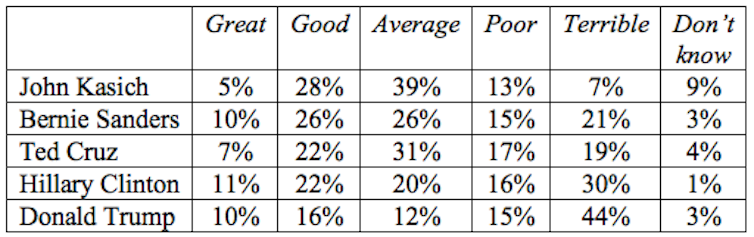 Pew Research poll, March 17-27, 2016, including 1,787 registered voters. Pew Research Center
Calculating the majority judgment ranking of the candidates is straightforward. Start at each end of the rating scale and add up the percentages until a majority of opinions are reached. Take the example of John Kasich: 5% think it would be “Great”, 5 + 28 = 33% think it would be “good” or better, and 33 + 39 = 72% (i.e. the majority) think that he would be “average” or even better. So Kasich’s majority grade is “average”.
The tiebreaker between candidates with the same majority grade is determined by the size of the blocks for or against their majority grade. Thus, the candidates who come out on top are Kasich and Sanders. Clinton and Trump come in last, and yet they were the ones nominated by their party.
The situation in 2020
In a Pew Research Center poll from June 2020, people assessed the two presidential candidates in the following way:
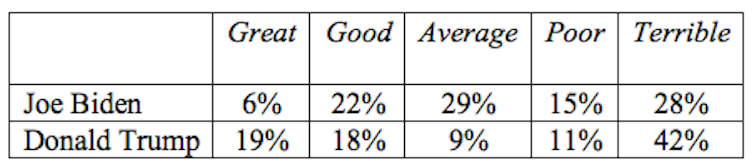
Pew Research poll, June 16-22, 2020, including 3,577 registered voters. Pew Research Center
The majority judgment winner is Joe Biden with the majority grade “average” against Trump with the majority grade “poor”. However, these results also reveal that Donald Trump is more appreciated than he was in 2016 (he has more “great” and “good”) and that Biden seems less well appreciated than Hillary Clinton was in 2016.
The fact that Trump is a better situation is best seen from the tables below. Republicans seem more enthusiastic about Trump in 2020 (42% “great”, 40% “good”) compared to 2016 (22% “great”, 41% “good”). Conversely, Democrats seemed more enthusiastic about Clinton in 2016 (16% “great”, 56% “good”) than they do about Biden in 2020 (11% “great”, 40% “good”).
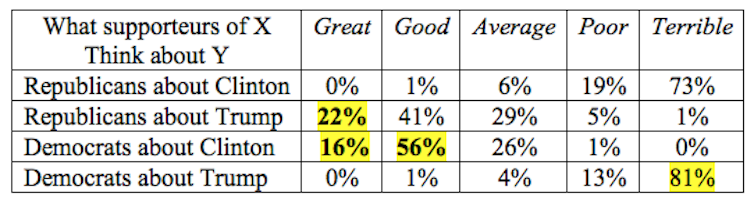
Pew Research poll, October 20-25, 2016. Pew Research Center
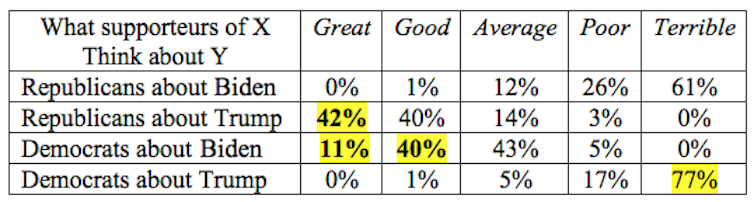
Pew Research poll, June 16-22, 2020. Pew Research Center, CC BY
It is time to change the way we vote
More than 20% of the voters dislike both Trump and Biden, believing that neither of them would make a good president. However, with majority voting, they will be forced to choose one of the two. As a result, some will abstain, some will vote for a fringe candidate, while others will decide at the last minute. What this means is that the outcome of the election will, arguably, be a random variable that is determined by the latest news story (that might be made up) or news, or the Supreme Court.
With majority judgment, on the other hand, voters could give their opinion on the main candidates as well as the fringe candidates and do so accurately. If a voter thinks one of the two main candidates is “poor” and the other “terrible”, they can express that a difference on the ballot. But with majority voting, this voter’s views will be ignored.







