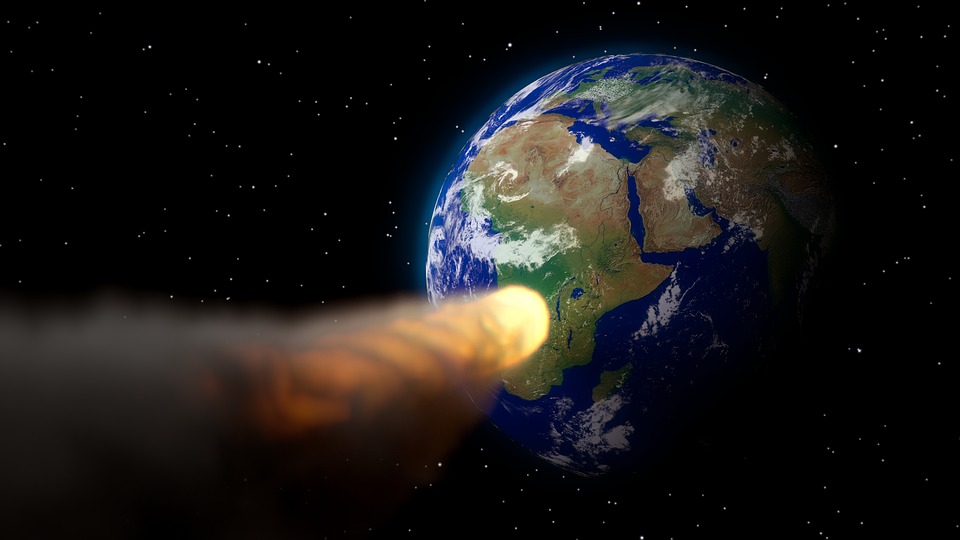
It’s a general rule to trust governments and space agencies to be able to do things like detect oncoming asteroids that might impact the earth at some point. However, a recent incident proves that there are still holes in the web that has already been cast. A previously undetected asteroid the size of a football field just missed the Earth have the distance to the Moon, and no one saw it until the last minute.
The asteroid was first detected by astronomers over at the Catalina Sky Survey on Saturday, April 14th, EarthSky reports. It has since been labeled 2018 GE3 and it passed by the planet at close range mere hours after detection.
In terms of actual implications, this case might not seem like a big deal since it didn’t really cause any damages. However, the simple fact that the Earth only had mere hours after detection of the asteroid paints a disturbing picture. If it hadn’t been a near miss but an actual impact, there would have been nothing that anyone could have done.
Even evacuating people out of affected areas around the impact zone would have done very little to actually mitigate the damage. An explosion comparable to an atom bomb’s yield might not have been out of the question. After all, it’s happened about 26 times since 2000, according to scientists.
This isn’t the first near-miss of this distance that has occurred over the recent years either, CNET reports. Since 2001, at least two other instances of asteroids coming dangerously close to Earth have occurred and those space rocks were much bigger than 2018 GE3.
At this point, the only thing that scientists can really do is ramp up their game so that they can improve the plant’s detection capabilities. If they can’t, failing to detect an asteroid could happen again and it could come with devastating consequences next time.