


 Bitcoin Price Falls Below $83K as Liquidations Hit $697M
  Solana Price Drops 3% Despite Samsung USDC Partnership
  Dogecoin Liquidations Surge as DOGE Bulls Face Heavy Losses
  Circle Stock Falls 4% as Crypto Selloff Overshadows SAP Pay Expansion
  Evernorth XRPN Nasdaq Listing Delayed to October 12
  Kazakhstan and Tether Explore Tenge Stablecoin and RWA Tokenization
  US Government Moves $1 Billion in Bitcoin Amid Sale Speculation
  David Schwartz to Reveal XRP Ledger Future at Ripple Swell 2026
  Cardano Hits Record 436 TPS as Network Scaling Advances
  Litecoin Marks 15 Years as Grayscale Backs LTC ETF Push
  DogecoinVM Makes DOGE Transactions 300x Faster


 Add as a preferred source on Google
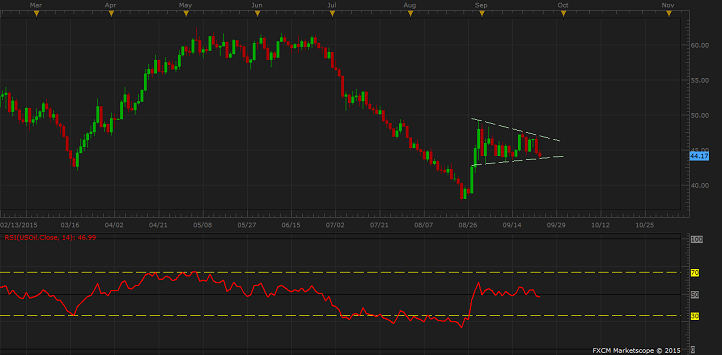
WTI crude prices jumped back sharply after reaching lowest level since the crisis at $38/barrel in late August as concern over Chinese slowdown and forceful Yuan devaluation by China weighed in.
- Chinese Yuan devaluation was more of a last resort to reduce the pressure on Yuan as capital kept on flowing out of the country. With China consuming about 12% of global oil production, slowdown concern has hit the market hard.
- While China's case is bearish for oil, recent report from OPEC and production slowdown in US has energized the bulls. According to OPEC, non-OPEC oil production is likely to slow down fast, reducing 1 million barrels/day supply from the market by 2017.
Naturally both bulls and bears are engaged in tough battle and pushed WTI into consolidation mode in September.
Price squeeze and formation of triangle suggests that breakout in WTI is ahead.
A downside break is more likely, though it can't be said with full certainty. $43/barrel area remains key challenge for the bears. Bulls are struggling to break free of $48/barrel area.
WTI is currently trading at $44.1/barrel, a break is likely to push prices lower to test 2008/09 low around $35/barrel.







