It seems ECB is increasingly pressurized but it is conditional on how it can deal with recent financial market stress, magnified risks for european banks, although sentiment-driven, but has both macroeconomic and bank-specific factors behind it.
Banks' net interest margins have been squeezed due to the negative deposit rate policy pursued by the ECB and the situation will only likely worsen as the current adverse inflation outlook points to further easing - we expect another 20 bps cut from ECB, which is to increase the pressures on banks' profitability, in turn on this uncertainty it may bring currency risks to euro against major currency crosses.
Medium-term inflation expectations, as measured by 5y5y HICP inflation swaps are now trading at all-time low levels, certainly pressuring the ECB to ease policy further. While we believe further depo rate cuts are an option for the ECB, we see relatively limited room for such action as deeply negative rates affect banks' profitability and financial stability.
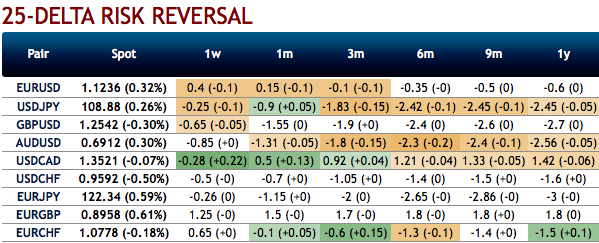
This week's EU Summit (on 18th - 19th February) would be the next risk event not only for the GBP but for some euro crosses outside euro zone such as EURJPY, EURUSD etc with significant implications for the timing of the EU Referendum. As a result OTC market positions are getting intensified, see IVs for all euro crosses are spiking up including EURCHF.
Please be noted that the risk reversal numbers in long run that indicate downside risk sentiments in this pair, rising implied volatilities to justify these positions and OTC VIX is matching with these computations. Contemplating all these aspects (macroeconomic trend, BoJ's policy measures, risk reversal and volatility indications) we eye on put ratio back spreads to hedge the potential downside risks.
Should the ECB decide to cut aggressively, a multi-tier deposit scheme similar to the BoJ would be necessary to attenuate the effect on banks.
More importantly, the recent market moves have certainly increased downside risks for EA private investment, putting pressure on the long-term debt dynamics of large EA sovereigns. This may pressure the fragile investment recovery and eventually slow consumption, adding an additional headwind for the ECB. A meaningful turn in the EUR will require a sustained and convincing pickup in investment or acceleration in core inflation that call into question the ECB's commitments.
Neither appears to be a possibility anytime soon and with downside risks to investment now likely, we remain bearish on the EUR over the medium term and continue to forecast material EURUSD downside in the coming quarters.
Although acknowledging that in the very near term, euro area home bias and the EUR's behavior as a funding currency could keep EURUSD supported, particularly in an environment in which the USD weakens further.