


 Litecoin Marks 15 Years as Grayscale Backs LTC ETF Push
  Fed’s Hammack Says Bond Yield Surge Is Not Driven by Inflation Fears
  Fed Unveils Stablecoin Rules Under GENIUS Act
  BOJ Raises Interest Rate to 31-Year High as Yen Weakens
  Australia Consumer Confidence Plunges as RBA Rate Hike Hits Households
  Oil Prices Rise as Gulf Hurricane and Middle East Supply Risks Mount
  Gold Prices Rise as Dollar Weakens, Treasury Yields Ease
  Yen in Focus as BOJ, Fed Rate Hikes Reshape Currency Markets
  US-Led Coalition Targets Global Factory Overcapacity
  RBI Uses $10 Billion Currency Swaps to Drain Excess Rupee Liquidity
  Fed Unveils Stablecoin Rules Under GENIUS Act
  European Stocks Fall as Oil Rises Ahead of Fed Minutes
  Zcash Mining Profits Surge as Liquidity Risks Grow


 Add as a preferred source on Google
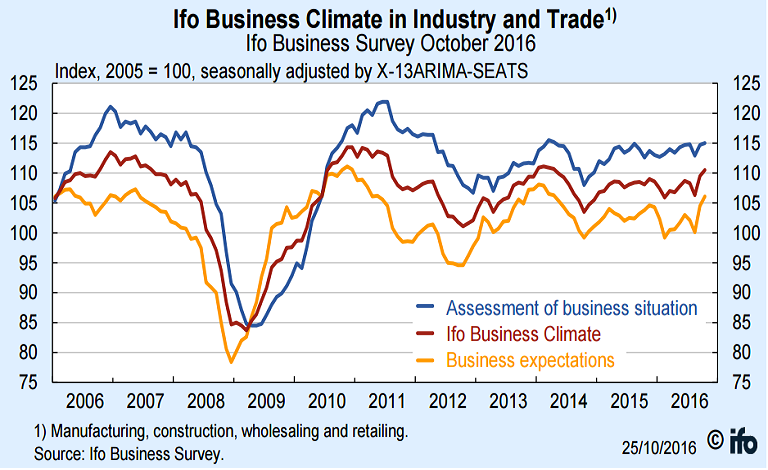
Germany’s economic performance has been the driving force of the euro area’s recovery so far, and upbeat business confidence in October suggests that the German economy is on track for more robust growth. Brexit vote had temporarily unsettled companies in Germany, but recent data show signs of upward trend.
Data released on Tuesday by the Munich-based Ifo institute, showed that German business confidence in October improved to the highest level since April 2014, signalling uncertainty over Brexit continued to abate. German business climate index climbed to 110.5 from 109.5 in September, Business Expectations Index rose to 106.1 from 104.5 and Current Assessment Index increased to 115.0 from 114.7.
German GDP data is due on Nov. 15 and economists surveyed by Bloomberg expect Q3 GDP growth of 0.3 percent after 0.4 percent in the previous three months. However, the Bundesbank in its 'Monthly Report' released on Monday, has dismissed weaker growth in Q3 as temporary and said that underlying momentum remains strong. Export and business expectations in manufacturing suggest the situation could improve in the coming month, the central bank added.
Latest German data overall has also suggested a significant improvement at the start of the fourth quarter. The latest German PMI data, released on Monday, showed a strengthening in the manufacturing sector to a 33-month high and a notable recovery in the services sector. German out-performance would certainly complicate ECB policy making and Bundesbank opposition to an extension of bond purchases would tend to intensify.
While Germany’s economy may be headed for a pick-up, data suggest that the rest of Europe will continue expanding at a slower pace. Separate report released by official statistics office INSEE on Tuesday showed that France manufacturing confidence dropped slightly to 102 in October from 103.
"In Germany, growth may even have accelerated toward the end of the year. With other parts of the eurozone, particularly France and Italy, performing far worse than their larger neighbor, the ECB will remain under pressure to offer more policy support to achieve its region-wide inflation goal,” said Jennifer McKeown, chief European economist at Capital Economics.
EUR/USD largely muted on upbeat German Ifo data. The pair was 0.04 percent lower, trading at 1.0875 at around 12:00 GMT.







