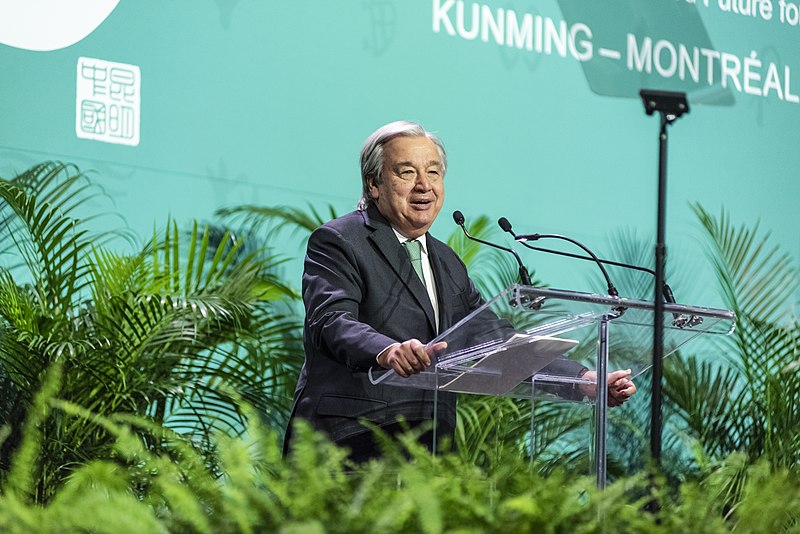
United Nations Secretary-General Antonio Guterres criticized the Taliban authorities in Afghanistan for barring the UN’s female Afghan workers. The ban is the latest in increasingly restrictive policies the insurgent group has imposed on women in Afghanistan.
Guterres on Wednesday condemned the latest ban by the Taliban on Afghan women working for the UN. This follows the move by the UN telling around 3,300 Afghan staff, 400 of which are women, not to report to their offices until further notice, citing security reasons. Around 600 international staff in Afghanistan are not affected by the ban.
“Banning Afghan women from working with the UN in Afghanistan is an intolerable violation of the most basic human rights,” tweeted Guterres. “I call on the Taliban to immediately revoke this decision.”
Diplomats said the UN Security Council is set to discuss the situation in a closed-door meeting on Friday. Top UN officials in Afghanistan’s capital Kabul met with acting Afghan foreign minister Amir Khan Muttaqi on Wednesday following the authorities signaling the ban on Afghan women working for the UN.
Deputy UN ambassador to Afghanistan Ramiz Alakbarov, who also serves as the humanitarian aid coordinator, said Muttaqi told them that the ban on Afghan women UN workers was an extension of the December order that barred Afghan women from working for aid groups. When pressed by reporters on whether it was worth it for the UN to stay and work under these restrictions, Alakbarov stressed that Afghanistan “cannot be abandoned.”
UN Deputy Secretary-General Amina Mohammed, who visited Afghanistan in January to meet with the Taliban authorities, told reporters that Afghan female UN workers would still be paid and would not be replaced by men.
“On a personal note, I am outraged. I am terribly troubled by the fact that in the month of Ramadan…what we get from the Taliban is a strike against the teaching and the belief of Islam,” said Mohammed.
Since taking over Afghanistan in 2021, the Taliban have introduced increasingly restrictive policies against women and girls despite pledging to uphold women’s rights in line with their interpretation of Islam.
Early this week, a Taliban official said it shut down a women-run radio station in northeastern Afghanistan, citing that said station was playing music during the month of Ramadan. The station’s head denied playing any music, criticizing the closure as unnecessary and a conspiracy.