


 Oil Prices Slip as Trump Rules Out Iran Strike Before Midterms
  Trump Secures Russian Diesel Deal as US Fuel Prices Surge
  Oil Prices Trim Gains After Trump Rules Out Iran Strikes Before Midterms
  Bank of America Predicts Yen Rebound as USD/JPY Faces Risks
  Crypto Market Selloff Wipes Out $100B as Bitcoin Falls Below $83K
  Deutsche Bank CEO Urges Faster German Economic Reforms
  Asian Stocks Mixed as OpenAI Revenue Concerns Hit Chipmakers
  FxWirePro: Daily Commodity Tracker - 21st March, 2022
  Oil Prices Rise as Gulf Hurricane and Middle East Supply Risks Mount


 Add as a preferred source on Google
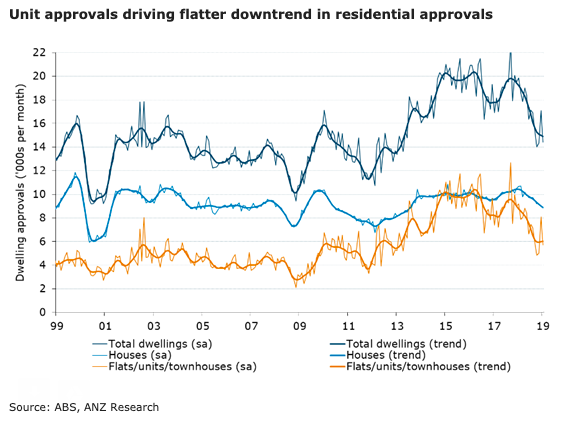
Australian building approvals declined sharply in March, correcting very strong growth in February. However, in trend terms, the decline in approvals of both dwellings and non-residential buildings are flattening. This suggests we may be past the peak period of falling building approvals after the sharp declines in late 2018, according to the latest report from ANZ Research.
The country’s residential building approvals fell 15.5 percent m/m in March, following a 19.1 percent increase in February. The drop in approvals was driven by private sector units, which declined 30.6 percent after jumping 64.5 percent in February. The decline in house approvals slowed in March, at only 3.1 percent m/m, compared with a drop of 3.5 percent m/m in February. Dwelling approvals are down 27.3 percent y/y.
Unit approvals are driving a flatter trend in residential approvals. In trend terms, unit approvals have flattened out at around 6,000 per month since November. This is a moderation from the peak of the trend during 2016, but is still higher than long-run historical trends, at around 4,000 per month.
NSW approvals fell by 27 percent m/m, exactly reversing the jump in February. NSW approvals have flattened out in trend terms over the past few months, but are still falling in trend terms in VIC and QLD. In contrast, the trend level of approvals is stable to higher in SA and WA.
Meanwhile, alterations and additions rose by 2.5 percent m/m in seasonally adjusted terms and 1.2 percent m/m in trend terms. The trend for alternations and additions has risen for the past seven months. The value of non-residential approvals fell by 8.7 percent m/m in seasonally adjusted terms, bringing the annual change in the trend to -12.1 percent y/y.







