


 Asian Stocks Mixed as OpenAI Revenue Concerns Hit Chipmakers
  Oil Prices Rise as Hormuz Risks Offset IEA Stock Release
  US, EU Push for Action Against Asia’s Excess Factory Capacity
  France to Release 10 Million Barrels of Diesel to Ease Fuel Prices
  Mike Rogers Calls for End to US-Canada Tariff War
  Oil Prices Rise as Gulf Hurricane and Middle East Supply Risks Mount
  US Dollar Rises for Fourth Week as Fed Rate Hike Bets Grow
  Iran Refuses to Halt Uranium Enrichment Amid US Nuclear Demands
  Gold Prices Fall Amid Rate Jitters; Copper Steady as China Stimulus Eyed
  FxWirePro: Daily Commodity Tracker - 21st March, 2022


 Add as a preferred source on Google
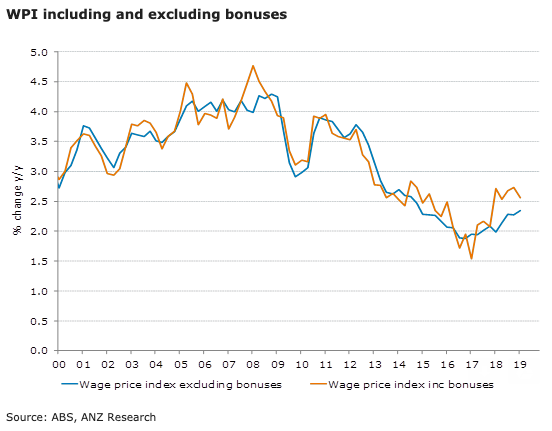
Australia’s annual wage growth steadied at 2.3 percent in Q1 2019. The quarterly result of 0.5 percent was marginally lower than expected but wasn’t far off 0.6% at two decimal places. Annual growth in wages including bonuses slowed from 2.7 percent to 2.6 percent.
It was a tale of two sectors: the public sector recorded its slowest quarterly growth in 19 years, while the private sector saw the strongest annual growth in four years.
The wage price index (WPI) rose by 0.5 percent q/q and 2.3 percent y/y in Q1. The quarterly result was slightly below market and our expectations; however, for the second quarter in a row, it was very close to being 0.6 percent (at 0.54 percent).
Public sector wage growth slowed again to 0.4 percent q/q, the weakest result since 2000, dropping annual growth to 2.4 percent. Private sector wages were steady at 0.5 percent q/q, upping annual growth to 2.4 percent, the strongest result in four years.
Including bonuses, public sector wages slowed to 2.4 percent y/y (from 2.5 percent) and private sector wages slowed to 2.7 percent y/y (from 2.8 percent).
Across industries, construction saw the slowest wage growth, at 1.8 percent (down from 1.9 percent), followed by information media and telecommunications and retail trade. Health care maintained the strongest wage growth at 3.0 percent. Mining (1.8 percent to 2.3 percent) and professional services (2.1 percent to 2.5 percent) improved the most.
New South Wales saw annual wage growth slow from 2.4 percent to 2.3 percent, with growth in South Australia and Tasmania also slowing. The Northern Territory (2.2 percent to 2.4 percent) and the ACT (2.0 percent to 2.1 percent) recorded an acceleration in wage growth. Victoria maintained the strongest wage growth rate nationally of 2.7 percent, while Western Australia remained in the weakest position at 1.6 percent.
"The mixed results do not provide a clear signal to the RBA. Firms are finding it more difficult to source suitable labour, and labour underutilisation rates have declined, but wage growth is picking up at a glacial pace. Labour underutilisation needs to drop faster to generate faster wage growth," ANZ Research commented in its latest report.







