
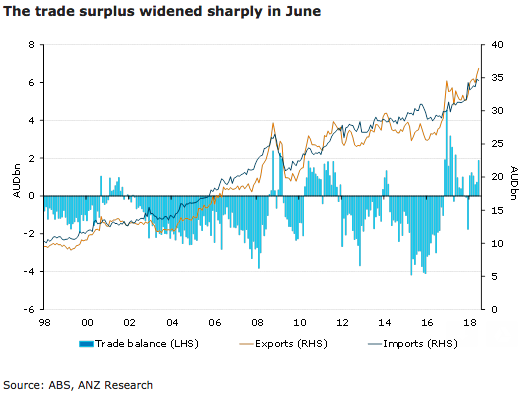
Australia’s trade surplus for the month of June beat market expectations, even after a slight downward revision to May’s surplus. Despite the strength in export values in the month of June it looks like net exports are set to have made no contribution to GDP growth in Q2, according to the latest report from ANZ Research.
The monthly trade balance widened to AUD1,873 million in June – the widest surplus since May 2017. The previous month’s surplus was revised down slightly to AUD725 million (from AUD827 million originally). June’s improvement reflected monthly export growth of 2.6 percent, while imports fell 0.7 percent.
Total export values rose by 2.6 percent m/m, leaving them 12.9 percent higher an on annual basis. The fastest gains were seen in manufacturing goods (4.9 percent m/m), with transport equipment rising 16.4 percent m/m. Rural goods rose 4.6 percent m/m led by a 10 percent m/m increase in exports of cereal grain and cereal preparations.
Total import values fell by 0.7 percent m/m in June, following a 3.4 percent increase in May. In annual terms imports are up 10.4 percent in value terms. The biggest drags on total imports were fuels (-10.8 percent m/m) and the volatile non-monetary gold segment (-14.9 percent m/m).
Imports of intermediate and other merchandise goods fell 3.6 percent, with parts for transport equipment down 5.4 percent and iron and steel down 5.9 percent. Consumption goods were down 0.2 percent, with non-industrial transport equipment down 3.3 percent and food and beverages up 2.2 percent. Capital goods rose, led by a 13 percent increase in civil aircraft.

