


 US Dollar Near 18-Month High Ahead of Inflation Data
  Trump Demands Powell Resign Over Fed Renovation Cost Overruns
  IMF, World Bank Meetings Face Global Economic Risks Amid Iran War
  Oil Prices Surge Above $106 After Deadly Saudi Airport Attack
  US Stock Futures Rise as Oil Prices Fall Ahead of Q3 Earnings
  Fed Minutes Signal Another Rate Hike by Year-End
  Nasdaq Falls as Oil Prices Surge Ahead of Bank Earnings
  Oil Prices Fall as Russia Signals Higher Diesel Exports
  Global Stocks Mixed as Oil Falls Ahead of US Earnings
  RBA Signals More Rate Hikes as Inflation Risks Rise
  US Dollar Rises for Fourth Week as Fed Rate Hike Bets Grow


 Add as a preferred source on Google
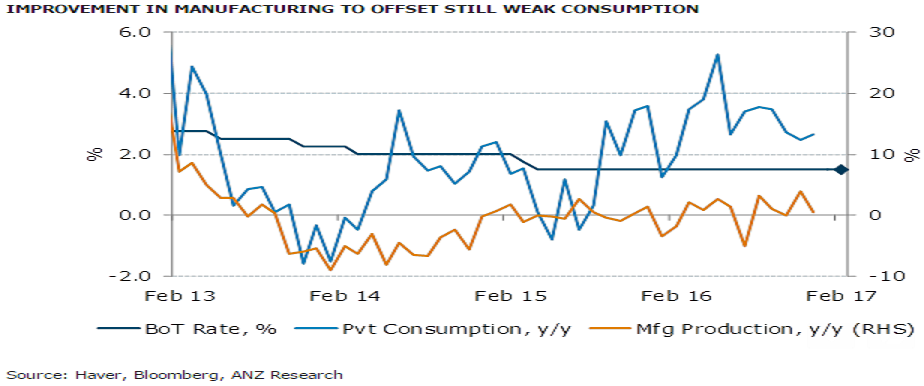
The Bank of Thailand (BoT) has kept its benchmark interest rate unchanged at the monetary policy meeting held Wednesday, in a unanimous decision by all members of the board. This is the 14th straight policy meeting where the central bank has kept its stance unchanged.
The BoT maintained its benchmark rate at 1.50 percent today, a move unanimously expected by all 22 analysts surveyed by Bloomberg. The central bank has kept its policy rate steady since May 2015.
The quarterly improvement in manufacturing production in Q4 likely provided a buffer to GDP growth. While the annual growth numbers in manufacturing are still soft, it is in line with the nascent recovery in export numbers.
However, private investment remains a drag on growth. The private investment index has been posting annual contractions for the past six months despite some improvement in the construction and equipment sub-indices. Meanwhile, credit growth eased to 3.2 percent y/y in December.
Also, domestic demand remains weak amid tepid credit growth and still contracting private investment. The credit conditions survey points to banks’ concerns over loan quality. Loan officers expect further tightening in banks’ credit standards in Q1 2017, which could keep private investment weak in the medium term.
"The BoT is unlikely to use interest rates to address their concern about the baht being too strong. We still see room for the central bank to keep its policy rate accommodative at 1.50 percent through 2017," ANZ said in its latest research report.







