


 World Bank Raises South Asia Growth Forecast to 6.9%
  Stellar Leads RWA Tokenization Growth With $36.4M Inflow
  Bitcoin Nears $87K as Crypto Market Gains
  BofA Raises Coinbase Stock Target to $203 on Stablecoin Growth
  Bitcoin Eyes $87,200 Breakout After Weak U.S. Jobs Data
  Cardano Price Surges 10% as ADA Targets $0.30
  OKXICE Files for 24/7 Tokenized US Stock Trading
  China Shuts 670 Banks as Bitcoin Eyes Financial Risks
  Sector Spotlight: Data Availability and Storage Lead 24-Hour Market Gains
  Euro Hits 17-Month Low as France Debt Fears Boost Dollar
  S&P 500 Hits Record High as AI Rally Lifts Wall Street
  XRP Ledger Batch Upgrade Set for October 9 Mainnet Launch
  Nasdaq Hits Record High as Tech Stocks Lift Wall Street
  Oil Prices Rise as Hormuz Attacks Fuel Supply Fears
  Ukraine Faces $56 Billion Budget Gap as War Costs Soar
  PUMP Price Surges 15% as Whales Accumulate $3.58M
  RBI Rate Hike Bets Surge as Inflation Rises


 Add as a preferred source on Google
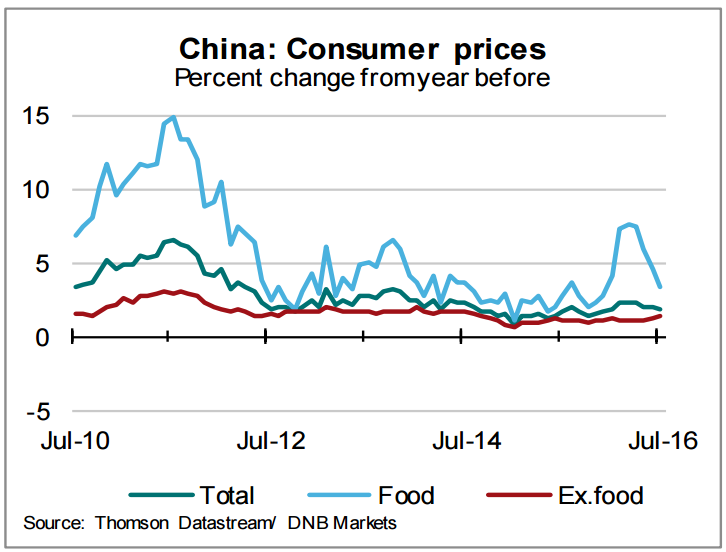
Data released earlier on Tuesday by the National Bureau of Statistics showed that China's CPI inflation came in at 1.8 percent y/y in July, largely in line with market expectations and compared to 1.9 percent in June. On a m/m basis, the CPI rose 0.2 percent in July, after four consecutive months of decline.
Food inflation fell 1.3pp to 3.3 percent y/y. Core-inflation (ex food) was up 0.2pp at 1.4 percent. Overall inflation fell due to lower food inflation, which was due to a drop in vegetable prices. Core inflation (ex-food) looked fairly stable. Vegetable prices, which rose a whopping 20 percent in the first half of the year, decelerated during the peak summer growing season contributing to the drop in the headline number.
China’s Producer Price Index fell 1.7 percent in July from a year earlier, which was a smaller decline than economists expected and compares with a 2.6 percent on-year drop in June. The index has lingered in deflationary territory for more than four years, but the decline has narrowed since the beginning of this year. China’s factory-gate deflation eased for the seventh straight month, signaling improving conditions for the nation’s manufacturers.
"Looking ahead, we expect headline consumer price inflation to begin to edge up again in the coming months. Non-food inflation is set to rise further as the drop in oil prices in the second half of 2015 provides a weaker base for comparison. Meanwhile, flooding in large parts of China last month, which damaged crops and killed livestock, will likely put upward pressure on food inflation in the short-run," said Capital Economics ' China economist Julian Evans-Pritchard.
People's Bank of China policymakers have an inflation target of around 3 percent. Price growth last year was 1.4 percent, a six-year low. Under-target mainland China inflation figure stoked expectations that the PBoC could move more aggressively to stimulus. Also, data released on Monday showed China’s imports fell by more than 12 percent in July, signaling weak domestic demand. And the official purchasing managers’ index in July dipped into contractionary territory for the first time since February.
“These price indicators are very stable compared to before,” said BBVA Research economist Xia Le. “But growth is still anemic. There’s still room for authorities to do more stimulus.”
Asian stocks rose to the highest level in almost a year as commodity producers rallied after Chinese data bolstered optimism that the world’s second-largest economy is stabilizing. China's CSI300 index closed up 0.7 pct at 3,256.98 points while Hong Kong’s Hang Seng index closed down 0.1 pct at 22,465.61 points.







