
We’re witnessing first-hand an alarming decline of the world’s ecosystems, which is having a devastating impact on the people who rely on them. In many cases, it’s no longer enough to just protect what remains – degraded ecosystems must be restored.
Expanding restoration efforts at the rate required will only be possible with committed buy-in from local communities, regional and national governments, civil society and – crucially – the corporate sector.
Many businesses are starting to embrace this vision by launching ambitious restoration projects to replant trees, wetlands, coral reefs and mangroves that far exceed their legal responsibilities.
These endeavours are promising. In some cases, these projects are even delivering significant benefits. But according to a study, which was carried out by myself and several colleagues, we can’t be sure whether large corporations are making good on these environmental promises.
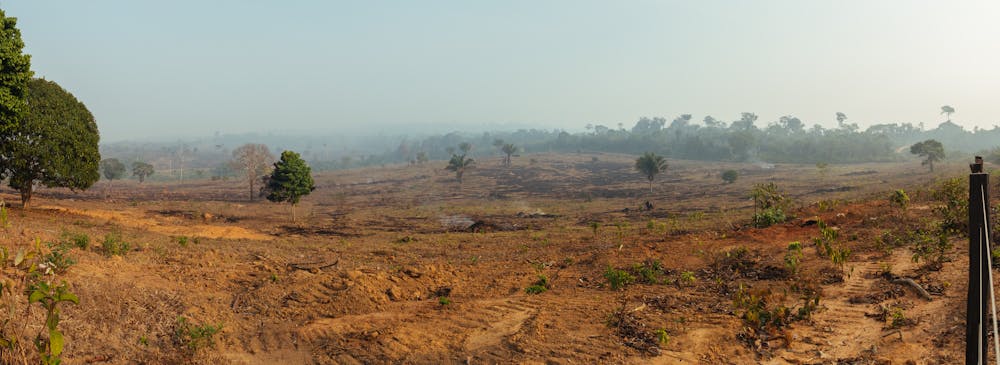
Deforested area in the Santarem region of the Brazilian Amazon. Adam Ronan/ Rede Amazonia Sustentvel, CC BY-NC-SA
The hidden reality
We delved into the publicly available sustainability reports of 100 of the world’s biggest businesses. Our aim was to summarise the extent of their restoration work and its impacts.
What we found was both eye-opening and disconcerting. Two-thirds of these corporations stated that they carry out restoration activities. But the devil lay in the detail — or, in this case, the lack thereof.
Many of the corporate sustainability reports gave very little evidence to back up their claims about ecosystem restoration. They lacked rigour in defining restoration, outlining methodologies and quantifying outcomes.
They also failed to clearly distinguish between projects designed to merely align with legal responsibilities and those that would genuinely contribute to global restoration goals.
The majority (80%) of the reports failed to disclose how much money they were spending on ecosystem restoration. And 90% didn’t report any of the ecological impacts that their work had. A third of the reports didn’t even say how big their projects were.
In essence, the evidence supporting many corporate-led ecosystem restoration projects is glaringly inadequate.
The potential power of ‘Big Business’
The world’s largest businesses are powerful entities. They possess the resources, wealth, logistics expertise and influence to play a pivotal role in the mission to restore the world’s ecosystems.
Imagine a world where corporations use their vast finances, labour forces, manufacturing capabilities and social influence help rebuild forests, wetlands, savannas and coral reefs around the globe. It’s a vision of corporate responsibility that goes beyond mere compliance with environmental regulations.
But ecosystem restoration is notoriously difficult to do well. It requires careful and strategic consideration of a range of environmental and social factors.
Genuine attempts to restore ecosystems can sometimes do more harm than good. They can, for example, accidentally cause environmental damage, disempower local people and landowners or destabilise local governance. Some corporations also oversell their efforts to gain an undeserved boost to their reputation (a practice known as “greenwashing”).

Coral restoration in Indonesia. Martin Colognoli/Ocean Image Bank, CC BY-NC-SA
Improving transparency and accountability
Better reporting will be essential for big businesses to become genuine leaders of global ecosystem restoration. It will allow us to properly track the progress of corporate-led initiatives, hold businesses to account against the claims they make, and learn from those businesses that are leading the way.
In our paper, we suggest that the rigour of corporate reporting could be improved by implementing several key principles taken from restoration science.
For example, corporate sustainability reports could better meet the principle of “proportionality” (understanding how much restoration activity has been carried out) by providing information about the spatial extent and number of organisms planted in each individual restoration project that a company carries out. It would then be possible to evaluate the likely scale of the project’s impact.
The principle of “permanence” (committing to long-term restoration commitments) could be better evidenced by companies reporting on the number of years they’ve committed to maintain, monitor and report on projects after they’ve been started.
By reporting in ways that adhere to scientific principles like these, companies will be able to demonstrate much more convincingly that their efforts in ecosystem restoration are delivering the environmental and social benefits that they claim.

A smallholder shows urucum produced in the Santarem region of the Brazilian Amazon. Marizilda Cruppe Rede/Amazonia Sustentavel, CC BY-NC-SA
Big business is showing an increasing interest in contributing to global sustainability. As part of this movement, corporate-led ecosystem restoration could become a valuable asset in the battle to protect our planet’s vulnerable ecosystems. But it will only work if we can ensure transparency, accountability and adherence to best practice.
The idea of big business helping to rebuild the planet is an alluring rhetoric. Now it’s time to back it up with evidence.