
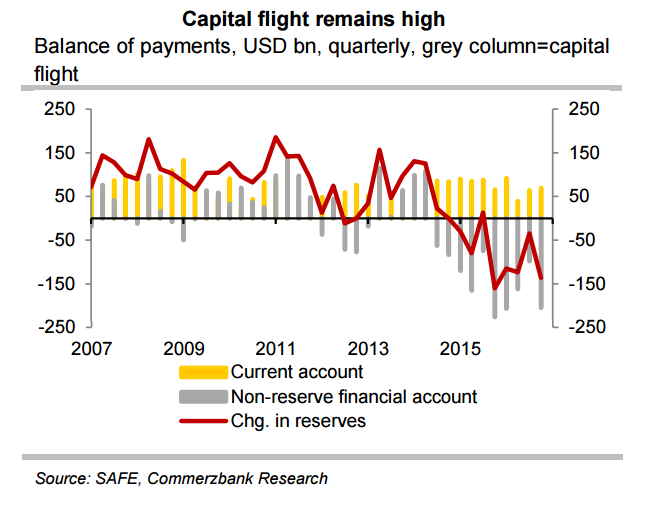
China's foreign exchange reserves unexpectedly fell below the crucial $3 trillion level in January for the first time in nearly six years despite efforts by authorities to curb outflows by tightening capital controls. The speed at which the country is depleting its foreign exchange reserves is highlighting the nation's unsustainable current currency policy.
Unless the Chinese authorities are able to encourage more foreign inflows, there is likely to be further capital outflows in the near term. Data has raised concerns among analysts that continued outflows will prompt the Chinese authorities to devalue their currency. To maintain stability in the RMB Index the PBoC will have to allow the RMB to adjust more freely, which would mean letting it weaken further.
China may be nearing the point where a significant devaluation of the currency would become necessary. However, there are reasons why the authorities would want to avoid a sharp weakening of the yuan anytime soon. Global debate on currency manipulation has seen a resurgence. The U.S. trade adviser has recently blamed Germany for benefiting from a weak euro and Trump himself has previously criticized Japan and China for having a weak exchange rate.
A sharp bilateral weakening would provide the Trump administration with the ammunition to declare China to be a “currency manipulator” and impose trade or investment-related sanctions. The authorities will do everything they can to avoid a hard yuan landing before the party congress.
"In our view controlled depreciation will remain the central issue for CNY for the foreseeable future. We expect USD-CNY to trade at 7.15 in late 2017 and 7.40 in late 2018," said Commerzbank in a report.
PBOC today set Yuan mid-point at 6.8710/dollar vs last close 6.8715. USD/CNY made intraday high at 6.8710 and low at 6.8613 levels. Intraday bias remains slightly bullish. A sustained close above 6.86 marks will test key resistances at 6.8823. Alternatively, a daily close below 6.86 will drag the pair down towards key support at 6.8550.
FxWirePro's Hourly USD Spot Index was at 111.641 (Highly Bullish), while Hourly CNY Spot Index was at -158.554 (Highly Bearish) at 1215 GMT. For more details on FxWirePro's Currency Strength Index, visit http://www.fxwirepro.com/currencyindex.


