


 US-Led Coalition Targets Global Factory Overcapacity
  Wall Street Falls as Oil Prices Rise and Tech Stocks Slide
  US, EU Push for Action Against Asia’s Excess Factory Capacity
  Best Gold Stocks to Buy Now: AABB, GOLD, GDX
  Fed Minutes Signal Another Rate Hike by Year-End
  Mike Rogers Calls for End to US-Canada Tariff War
  Oil Prices Rise as Gulf Hurricane and Middle East Supply Risks Mount
  US Dollar Rises for Fourth Week as Fed Rate Hike Bets Grow
  Iran Refuses to Halt Uranium Enrichment Amid US Nuclear Demands
  Gold Prices Fall Amid Rate Jitters; Copper Steady as China Stimulus Eyed
  Oil Prices Slip as Trump Rules Out Iran Strike Before Midterms


 Add as a preferred source on Google
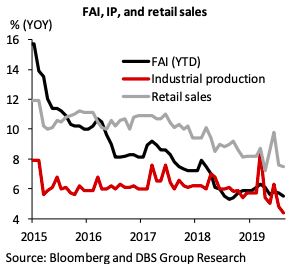
China’s economy slowed further in August, with industrial production growing at the weakest pace in more than 17 years; Industrial production rose 4.4 percent y/y in August, the lowest since 2002 and slower than the 4.8 percent growth in July, DBS Group Research reported.
Fixed asset investment rose 5.5 percent YTD, down from 5.7 percent previous month. Infrastructure investment accelerated but was not sufficient to offset the slowdown in private investment. Retail sales growth slowed to 7.5 percent, compared with 7.6 percent in July. Auto sales fell 8.1 percent after declining 2.6 percent previous month.
Leading indicators showed mixed signals. Caixin manufacturing PMI increased to 50.4 in August from 49.9 previous month. But trends on the supply and demand side diverged, with rising output but falling new orders. Notably, new export orders slid deeper into contractionary territory.
Demand for credit was lacklustre amid rising uncertainty. Growth in total social financing remained flat at 10.7 percent in August, while loan growth retreated by 0.2pp to 12.4 percent. The impact of targeted policy easing has so far been limited.
Since early 2018, PBoC has injected more than RMB3.6 trillion in net liquidity through seven reserve cuts. However, financing costs for the real economy has failed to decline. The weighted average lending rates have remained broadly unchanged in the past three quarters (5.66 percent for Q2 2019; 5.69 percent for Q1 2019; 5.64 percent for Q4 2018). M2 stayed historically low, albeit edging up 0.1pp to 8.2 percent in August.
"We expect Beijing to strive to put a floor under the economy. A rate above 6 percent in 2019 and 2020 would be needed to double 2010 GDP by next year. We expect PBoC to lower RRR by another 50-100bps in Q4. Property, however, will unlikely be used as a short-term means of stimulating the economy given the still-elevated home prices," the report further commented.







