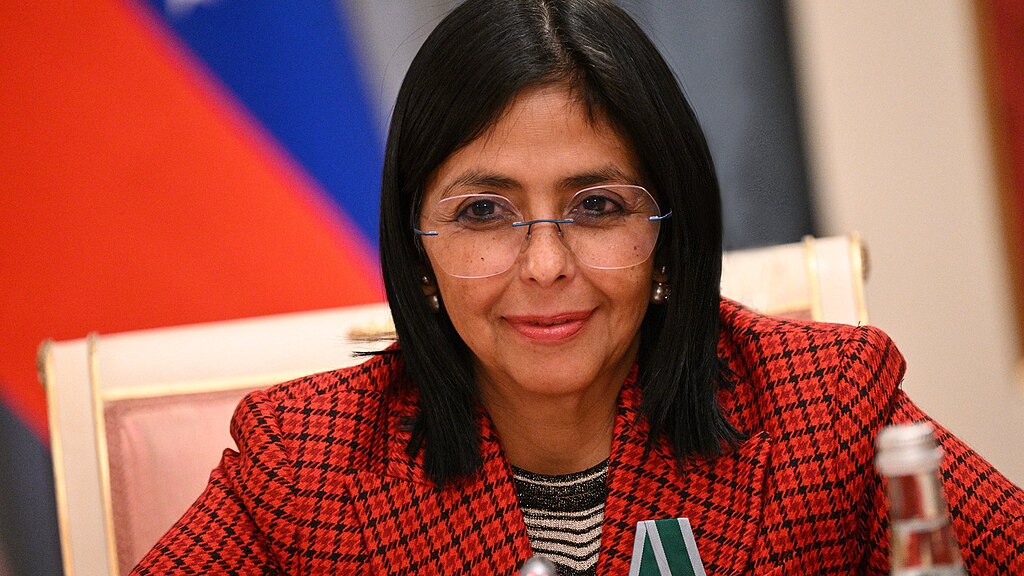
Venezuela Vice President Delcy Rodriguez has once again emerged at the center of international attention after firmly rejecting claims by U.S. President Donald Trump that she had been sworn in as the country’s new president following the reported capture of Nicolas Maduro by U.S. forces. Speaking on state television in Caracas, Rodriguez insisted that Maduro remains Venezuela’s only legitimate president, directly contradicting Trump’s assertion that the United States would temporarily run the country and that Rodriguez was prepared to cooperate with Washington.
State media footage showed Rodriguez addressing the nation despite earlier reports suggesting she was in Russia, leaving uncertainty about her exact whereabouts. In her remarks, she also called on the U.S. government to provide proof of life for Maduro and his wife, underscoring the escalating political tension surrounding Venezuela’s leadership and sovereignty.
Rodriguez, 56, is one of the most influential figures in Maduro’s socialist government. Born on May 18, 1969, in Caracas, she is the daughter of Jorge Antonio Rodriguez, a left-wing guerrilla fighter and founder of the revolutionary Liga Socialista party in the 1970s. Maduro has often referred to her as a “tiger,” praising her fierce loyalty and uncompromising defense of his administration.
An attorney by training and a graduate of the Universidad Central de Venezuela, Rodriguez rose rapidly through the political ranks over the past decade. She served as Communication and Information Minister between 2013 and 2014, later becoming foreign minister from 2014 to 2017. During her tenure as foreign minister, she made headlines for attempting to force her way into a Mercosur trade bloc meeting in Buenos Aires after Venezuela was suspended from the group.
In 2017, Rodriguez became head of the pro-government Constituent Assembly that significantly expanded Maduro’s powers. She was appointed vice president in June 2018, with Maduro publicly lauding her revolutionary credentials. Holding multiple roles simultaneously, including finance and oil minister, Rodriguez has played a central role in managing Venezuela’s battered economy. She has pursued relatively orthodox economic policies to combat hyperinflation and maintain relations with the weakened private sector.
In August 2024, Maduro added the oil ministry to her portfolio, tasking her with navigating escalating U.S. sanctions on Venezuela’s most critical industry. Known for her polished public image and fondness for designer fashion, Rodriguez continues to be a key power broker as Venezuela faces one of the most volatile moments in its modern political history.