Whilst the outbreak of a potentially deadly disease is never going to be promoted as good news, in the future, reporters may be able to put a positive spin on the coronavirus outbreak that is currently occupying the news headlines across the world.
With the coronavirus sweeping the globe and countries already on lockdown, millions of workers are being told to work from home, forcing the largest exercise in remote working in modern times. Although significant, this potentially pioneering shift in working behaviour is not as drastic as it would have been 30 years ago. Thanks to the internet, the rise of computer-based job roles and the 2009 recession, remote working and home offices have been on the rise since the turn of the century.
Many white-collar jobs can be done anywhere in the world, as long as there is access to a computer and an internet connection. The rise in remote working and increasing trend of home-based-entrepreneurs has created a B2B sector of its own. Virtual offices, virtual addresses, conferencing software and telephone answering services providing the ability to run a business remotely.
This has led to the development & expansion of international businesses including Moneypenny and Zoom who now employee nearly 3,000 individuals. Their success is not only due to the increase in remote working. Many of these virtual services, allow home-based-entrepreneurs to appear as if they have a ‘bricks and mortar’ presence; something that inspires trust and a sense of professionalism that many look for before purchasing a service or product online.
Remote working is one thing but the coronavirus has also hit the manufacturing sector, especially in China where the reduction in carbon emissions is down by 25% in recent weeks. Whilst a fair proportion of the reduction is down to the dip in the economy and the slump in manufacturing, across the world the falling rate of greenhouse gas production is also attributed to the surge in remote working and the corresponding drop in carbon monoxide emissions from cars. Something that could hopefully have a long term, positive impact if the current ‘test’ proves successful and the trend is maintained.
The coronavirus also poses a threat to the environment, however. Whilst this microscopic pathogen has achieved more for the planet’s future than all the world’s politicians combined; there is a risk that a full-blown economic meltdown could see a reduction in the investment in renewable fuels. If investors become less willing to fund startups, for example, this could prevent the development of burgeoning innovative technologies that would have otherwise played a significant contribution in safeguarding the planet for future generations.
A drop in oil prices has already had a negative impact on the sale of electric cars, with Telsa stocks taking a huge plunge on Monday. Although the company share price has made a small recovery since it is unlikely to realise its pre-corona valuation until the economy makes a full recovery. There is also the issue of renewable energy equipment and asset production. With China, a big player in solar panel, inverters and cable production, for example, resellers across the world are either in a state of limbo or selling panels for inflated prices.
If we take a step back from the economic forecasting however and reapply our rose-tinted glasses, the increase in remote working that is undergoing an enforced testing process across the world at the moment will potentially have a long-lasting, positive impact on air quality and carbon emissions if productivity does not take a significant dip. This could mean a shift in the general functioning of many businesses and could open up a new economic vacuum for B2B services who can plug the gap in terms of provisioning for small to large, global businesses functioning without an office.
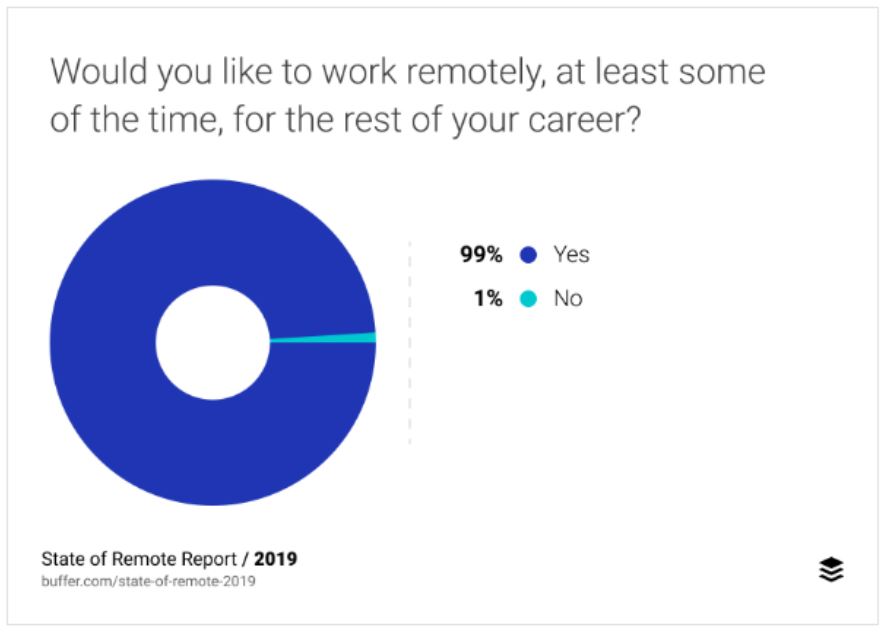
99% of Buffer’s Respondents stated that they would like to work remotely
Moreover, with fewer cars on the road, and more people working from home, this could see a significant reduction in car accidents. Quieter roads could also mean less stressful commutes, less burnout and more leisure time for many. With stress and mental health in general accounting for over half of all absences from work, any positive shift in mental wellbeing is good news for employers and the employees themselves.
This article does not necessarily reflect the opinions of the editors or management of EconoTimes.