


 RBI Rate Hike Bets Surge as Inflation Rises
  UBS Predicts Potential Fed Rate Cut Amid Strong US Economic Data
  BOJ Signals Faster Rate Hikes as Inflation Risks Grow
  Kazakhstan and Tether Explore Tenge Stablecoin and RWA Tokenization
  Bitcoin Outflows From Binance Hit Three-Year High as Whales Accumulate
  ECB May Stop Rate Hikes After December, Capital Economics Says
  Trump’s "Shock and Awe" Agenda: Executive Orders from Day One
  Sector Spotlight: Data Availability and Storage Lead 24-Hour Market Gains
  Urban studies: Doing research when every city is different
  S&P 500 Relies on Tech for Growth in Q4 2024, Says Barclays
  Fed May Resume Rate Hikes: BofA Analysts Outline Key Scenarios
  Oil Prices Dip Slightly Amid Focus on Russian Sanctions and U.S. Inflation Data
  Moldova Criticizes Russia Amid Transdniestria Energy Crisis
  Fed’s Hammack Says More Data Needed Before Next Rate Move


 Add as a preferred source on Google
We expect AUDUSD to decline through 2017 on skinnier rate differentials and a pull-back in commodity prices.
The Dec-17 target is 0.68, 10% below forwards. The combination of a more high conviction Fed cycle in 2017 and further RBA easing should see policy rate cross-over occur for the first time since the late 1990s.
This will leave minimal carry support for AUD, which is particularly important given its vulnerability to a turn in China’s momentum or adverse developments in global trade.
Bearish: AUD/USD below 0.73 if:
1) The labor market weakens forcing the RBA to respond more aggressively to weak inflation;
2) The Fed responds to animal spirits and bullish survey data by delivering a faster pace of hikes than currently expected;
3) Trade tensions and capital outflows force genuine CNY devaluation.
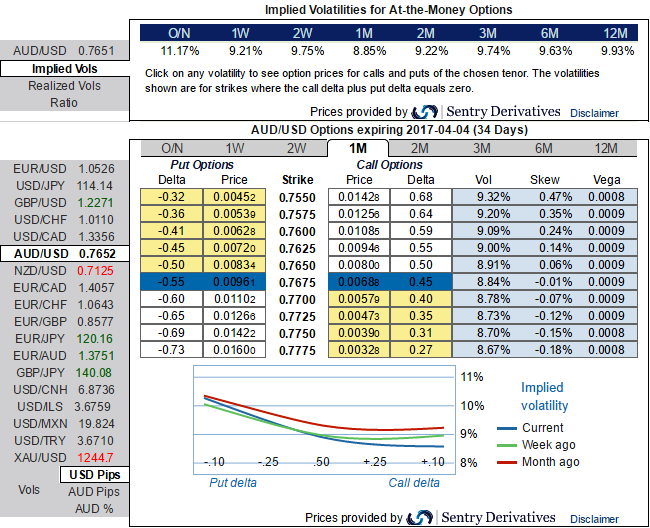
Accordingly, OTC hedging indications from the diagrams evidencing risk reversals and IV skews are in tandem with the above mentioned forecasts and its rationale.
Please be informed that the nutshell showing risk reversals are bids for the hedging for the downside risks, as a result, puts are on more demands over calls. The negative risk reversals across all tenors are indicating the bearish hedging interests.
Let’s also glance on sensitivity tool for 1-3m IV skews would signify the interests of OTM put strikes that would imply hedging sentiments are for downside risks in the underlying spot FX.







