


 Solana Alpenglow Upgrade Set for October 21: What It Means for SOL
  Dogecoin Price Rebounds as DOGE Defends $0.08 Support
  Fed May Resume Rate Hikes: BofA Analysts Outline Key Scenarios
  China’s Growth Faces Structural Challenges Amid Doubts Over Data
  UBS Predicts Potential Fed Rate Cut Amid Strong US Economic Data
  China's Refining Industry Faces Major Shakeup Amid Challenges
  Polygon Labs Completes Coinme Acquisition, Expands U.S. Payments
  Zcash Price Drops 30% as ZEC Tests Critical $1,120 Support
  Monero Price Holds $515 Support as XMR Eyes $545 Breakout
  Mexico's Undervalued Equity Market Offers Long-Term Investment Potential
  Morgan Stanley Predicts $10 Trillion RWA Market by 2030
  UBS Projects Mixed Market Outlook for 2025 Amid Trump Policy Uncertainty
  Wall Street Analysts Weigh in on Latest NFP Data
  Indonesia Surprises Markets with Interest Rate Cut Amid Currency Pressure
  DeFi Development Adds 22,070 SOL to Solana Treasury
  European Stocks Rally on Chinese Growth and Mining Merger Speculation
  Gold vs Bitcoin: Investors Eye Inflation Hedge as Crypto Adoption Grows


 Add as a preferred source on Google
The Mexican peso has come under depreciation pressure once again and this provided a first taste of what we are likely to face over the coming days.
We expect MXN to stabilize around 18.80 on domestic and NAFTA considerations. We mentioned MXN hedges at these levels were no longer necessary, yet admittedly further high-carry FX weakness will continue to spill-over into MXN as the typical hedging currency for the asset class.
On Wednesday the fifth round of the NAFTA renegotiations will start – two days before the originally planned date – it will run until 21st November. This round is not likely to be easy either. Controversial issues such as rules of origin, where the US demand a high US-share, will have to be negotiated.
That means the market is likely to remain nervous as there is a risk that the negotiations could fail and the free trade agreement will come to an end, which could drive the Mexican economy into a severe crisis.
Should an agreement be reached unexpectedly, the peso would of course quickly retrace the losses recorded over the past weeks, but at the moment it does not look as if that was going to happen.
Banxico’s announcement to intervene with an additional $4bn should also limit volatility in MXN, but more importantly, this opens the door for more intervention in the short term, putting a floor on MXN weakness in our view. Finally, the large increase in monthly remittances that we expect post a 10% move will likely help stabilize MXN, especially given the narrowing of the trade balance.
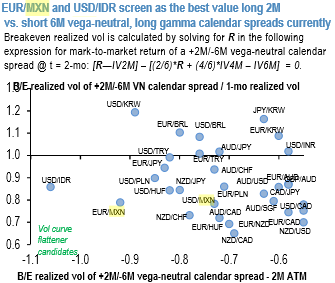
Subsidized gamma longs via +2M/-6M vega-neutral calendar spread that fade this curve steepness are good value in MXN and IDR.
We had flagged MXN and TRY as the two currencies where curve-based gamma longs offered good value; both delivered solid returns on the week judging from the above charts show that EURMXN still remains a favored gamma buy in vega-neutral calendar format.
MXN, like other petro-currencies, has decoupled from the surge in oil prices and responded more forcefully to idiosyncratic domestic (elections) and international (NAFTA) political factors, and is potentially susceptible to sharp mean-reversion stronger, especially after official FX intervention appears to have been successful in stemming runaway peso weakness.
Additionally, while it matters much less for short-tenor options, it does not hurt that EURMXN implied vols look historically underpriced in relation to the carry in forward points: the above chart shows that the carry/vol ratio of EURMXN straddles – defined as at expiry payout of the straddle assuming unchanged spot/current option premium – has spiked to levels last seen in the go-go pre-Lehman years, hence there is even a case for playing for near-term reversal of recent peso weakness via options. Courtesy: JPM







