


 Oil Prices Dip Slightly Amid Focus on Russian Sanctions and U.S. Inflation Data
  Ripple and Cardano Expand Blockchain Adoption in Brazil
  QNT Whales Move $10M to Exchanges After 400% Rally
  Fed Rate Hike Threatens Housing as U.S. Growth Leans on AI, Citi Says
  European Stocks Rally on Chinese Growth and Mining Merger Speculation
  Gold Prices Fall Amid Rate Jitters; Copper Steady as China Stimulus Eyed
  Japanese Yen Retreats as Dollar Rises Ahead of Fed, BOJ Rate Decisions
  XRP Rises as Evernorth Merger Vote Clears Key Nasdaq Hurdle
  Mexico's Undervalued Equity Market Offers Long-Term Investment Potential
  Coinbase, Visa Back Open USD Stablecoin Launch
  Cboe Extends SPX Options Deal, Eyes Tokenized Contracts
  US Futures Rise as Investors Eye Earnings, Inflation Data, and Wildfire Impacts
  ECB May Stop Rate Hikes After December, Capital Economics Says


 Add as a preferred source on Google
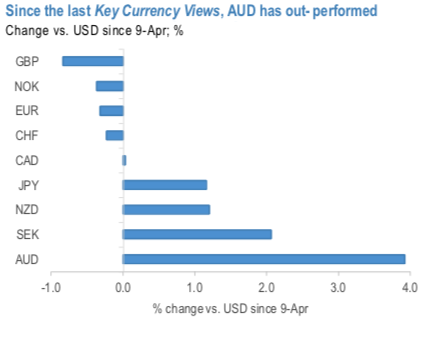
AUD has been the standout performer within G10 (refer 1st chart). Most of this rally occurred during April, and since then AUD has traded a very tight range (0.6370-0.6530). One new development for AUD has been an escalation of trade tensions with China. However, we have not made any changes to our forecasts; we see AUDUSD at 0.63 by mid-year (expecting some near term seasonal under-performance) and 0.65 by year end.
RBA is scheduled for their monetary policy for this week, of late, Aussie central bank’s policy settings have remained unchanged since being announced on 19 March. The Bank remains committed to leave the cash rate at current levels until “...progress is being made towards full employment and it is confident that inflation will be sustainably within the 2–3 per cent target band.” What has changed has been an easing of restrictions as Australia has made significant gains in managing the COVID-19 outbreak (refer 2nd chart). This gives us greater confidence in our central case forecast for a return to growth in 3Q’20.
The latest development for AUD has been an escalation of trade tensions with China (refer 3rd chart). Senior Chinese diplomats have recently expressed displeasure with Australia's support for an international inquiry on the origins of COVID-19 and have threatened the possibility of economic retaliation. In addition, China has raised the potential for 80% tariffs on Australian barley (in response to alleged dumping behaviour) and has this week banned imports from four Australian beef processors. The Australian government has so far played a straight bat to much of this noise, but it does serve to highlight that risks to Australia's exports to China are very asymmetric in a post COVID world where relations deteriorate and China uses economic coercion to punish Australia. This is a potentially large source of downside risk for AUD, and one that may cap any upside for AUS that exists on the basis of a relatively earlier return to economic activity, still solid iron ore prices and the RBA's "QE-lite" compared to other central banks.
We advocated shorting AUDUSD futures contracts of mid-month tenors on hedging grounds, we wish to uphold the same strategy as the underlying spot FX likely to target southwards below 0.65 levels in the medium run (spot reference: 0.6750 levels). Writers in a futures contract are expected to maintain margins in order to open and maintain a short futures position. Courtesy: JPM







