


 RBA Set for September Rate Hike as Inflation Stays High
  Bank of America Posts Strong Q4 2024 Results, Shares Rise
  Geopolitical Shocks That Could Reshape Financial Markets in 2025
  Urban studies: Doing research when every city is different
  Indonesia Surprises Markets with Interest Rate Cut Amid Currency Pressure
  BOJ Signals Faster Rate Hikes as Inflation Risks Grow
  Fed Rate Hike Threatens Housing as U.S. Growth Leans on AI, Citi Says
  UBS Predicts Potential Fed Rate Cut Amid Strong US Economic Data
  Wall Street Analysts Weigh in on Latest NFP Data
  Trump Demands Powell Resign Over Fed Renovation Cost Overruns
  Stock Futures Dip as Investors Await Key Payrolls Data


 Add as a preferred source on Google
If at all anything unexpected is going to happen in Mexican monetary policy, then we expect a single 25bp hike this year, in December.
Banxico backed off from its hawkish rhetoric of a couple of months ago, and in the Quarterly Inflation Report signaled no urgency to hike.
Inflation will most likely remain below the central bank’s target in the next months and will probably average less than 3% this year according to Banxico.
The Mexican peso has lost over 35% in value against the U.S. dollar over the past three years. Over a 24-month period, it has lost 30% of its value. The reasons for this are as follows:
- the fall in the oil price, which has also taken place over the past two years (traditionally moves in tandem with the peso);
- an increase in the national debt (partly because of the fall in the oil price);
- the fundamental weakening in global growth in the first half of 2016, and
- the escalating uncertainty on the international financial markets and emerging markets.
Another factor has been the Brexit vote in UK in June 2016. Apart from Mexico's current account deficit of around 2.5% of GDP – not a fundamental problem, in our view – the last six months have seen a certain withdrawal from the money market, which could have been a contributory factor behind the fall in the peso.
However, this portfolio outflow may also be seen as a reaction to the gradual increase in the interest rate and should not necessarily be regarded as a sort of capital migration. The last dampening factor for the peso worthy of mention is that the latest opinion polls show a greater likelihood of Donald Trump being elected as the next US president.
Hedging Strategy:
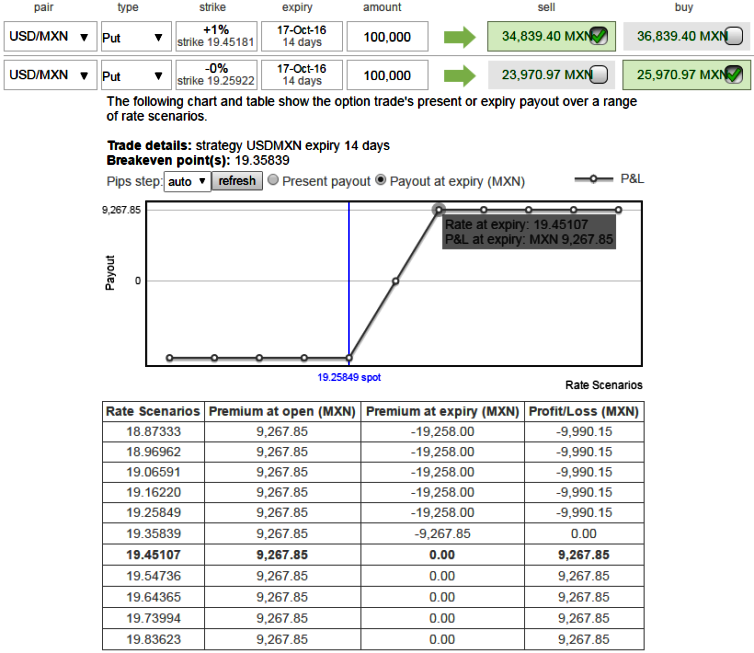
We’ve already advocated this option strategy in the recent past, we urge to maintain the same option portfolio as the FX OTC market for USDMXN is intensified ahead of above fundamental scenario, 2W IVs are spiking above 18.17%.
During such scenarios, Vega is the sensitivity of an option’s value to a change in volatility. It is usually expressed as the change in premium value per 1% change in implied volatility. Vega is generally larger in options which have a longer time until expiry, and it falls as the option approaches expiry.
As we expect the underlying currency exchange rate of USDMXN to make a larger move on the downside. As shown in the figure purchase 1M 2 lots of At-The-Money -0.52 delta puts and sell 1W one lot of (1%) In-The-Money put option.
Please be noted that the expiries shown in the diagram are for the demonstration purpose only, use appropriate tenors as stated above.







