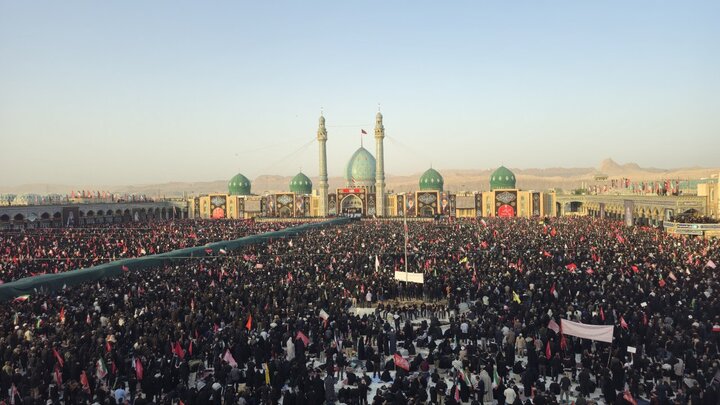
Iran buried slain Supreme Leader Ayatollah Ali Khamenei at the Imam Reza Shrine in Mashhad early Friday, concluding a week of large-scale funeral ceremonies marked by mourning, nationalist rallies and anti-U.S. demonstrations following the recent conflict with the United States and Israel.
Khamenei was killed in the opening strikes of the war launched by the United States and Israel on February 28. Although Washington and Tehran agreed to a truce last month, tensions remain high as Iran navigates the political and security fallout from the conflict.
Thousands of mourners lined the streets of Mashhad as Khamenei's coffin was carried toward the country's holiest Shi'ite shrine. Clerics accompanied the procession while crowds waved Iranian flags, displayed portraits of the late leader and chanted revolutionary slogans. A helicopter later transported the coffin over the packed crowd for the final stage of the burial ceremony.
State news agency IRNA confirmed that Khamenei and four family members killed in the same attack were buried at the shrine, one of Shi'ite Islam's most sacred pilgrimage sites and Khamenei's hometown.
The funeral also highlighted uncertainty surrounding Iran's new Supreme Leader, Mojtaba Khamenei, who has not appeared publicly since the war began. Iranian officials have said he suffered severe injuries in the strike that killed his father and remains under tight security while recovering. Since his appointment by the country's clerical leadership in March, he has communicated only through written statements.
During the funeral, crowds chanted anti-U.S. slogans and called for revenge against U.S. President Donald Trump, with some mourners displaying placards bearing hostile messages.
Khamenei's funeral concludes nearly four decades of his leadership, during which he consolidated political, military and economic authority while strengthening the influence of the Islamic Revolutionary Guard Corps. Analysts say Iran retained control of the strategic Strait of Hormuz despite the war, but the country now faces significant economic challenges, reconstruction costs and political uncertainty under Mojtaba Khamenei's leadership.