


 US Stock Futures Flat as Fed Minutes, Earnings Loom
  Chainlink Price Drops 3% Despite New CCIP Vault Launch
  Oil Prices Trim Gains After Trump Rules Out Iran Strikes Before Midterms
  European Stocks Fall as Oil Rises Ahead of Fed Minutes
  Fed Minutes Signal Another Rate Hike by Year-End
  Gold Prices Hit One-Week High as Oil Falls, Fed Rate Outlook Weighed
  XRP Holds Steady at $1.39 as Crypto Market Faces Heavy Liquidations
  Zcash Plans Quantum-Resistant Security Upgrade for January
  Oil Prices Rise as Gulf Hurricane and Middle East Supply Risks Mount
  Gold Prices Rise as Hormuz Tensions Fuel Inflation Risks
  Wall Street Falls as Oil Prices Rise and Tech Stocks Slide
  Stellar Overtakes Ethereum in RWA Fund Inflows as XRP Leads Commodities
  Deere, CNH and AGCO Stocks Fall as FTC Launches Farm Equipment Probe
  Ledger Investigates Alleged $86 Million Crypto Wallet Theft
  MSTR Stock Rises as Barclays Raises Price Target to $175


 Add as a preferred source on Google
The GDP data (-0.2%) for Q3 illustrated that Japan is in recession.
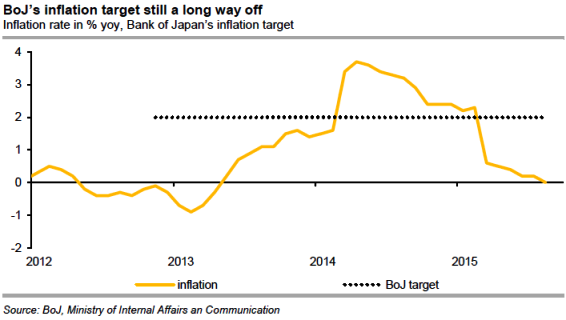
However, while the inflation rate remains at '0' because of which the BoJ cannot breathe a sigh of relief.
Unchanged unemployment claims were stubborn at 3.4% from previous.
If the economy is now also flagging the small flicker of hope that its inflation target of 2% could be reached by March 2017 is dwindling even further.
A tiny little positive signal on the inflation front is the GDP deflator that rose to 2.0% yoy. Even if it leaves everything unchanged at the moment, the BoJ will have to stand to attention.
The last meeting provided the perfect reason for this step as the BoJ corrected its growth and inflation outlook downwards.
As a result hardly any market participants expected the BoJ to take action today and it fulfilled this expectation.
In the end it can still wait and see and watch developments in USD/JPY once the Fed starts the normalization of its monetary policy.
However, it has become clear since Monday at the very latest that the BoJ will have no choice but to become more expansionary again.

- News

- Economy

- Central Banks
- Investing
- Research
- Roundups
- Digital Currency
- Insights
- Technical Analysis
- Technology
- Business
- Law
- Health
- Nature
- Fintech
- Science
- Topic
- Opinions
- ©Econometrics LLC . All Rights Reserved.
Japan sliding into recession mode, 2% inflation target still a major concern for BoJ
Friday, November 20, 2015 9:33 AM UTC
Editor's Picks



- Market Data
Most Popular




