AAP/Chris Crerar
With 79% counted in Saturday’s Tasmanian election, the ABC is calling 12 of the 25 Tasmanian lower house seats for the Liberals, eight for Labor, two Greens and three undecided. Vote shares were 48.7% Liberals (down 1.5% since the 2018 election), 28.4% Labor (down 4.3%), 12.2% Greens (up 1.9%) and 6.3% for independents.
Tasmania uses the Hare-Clark system, with five electorates each returning five members. A quota is one-sixth of the vote, or 16.7%.
In The Poll Bludger’s projections, the Liberals are on 3.6 quotas in Bass, Labor 1.6 and the Greens 0.6. The Liberals will win three, Labor one and the last is Labor vs Greens.
In Braddon, the Liberals have 3.4 quotas, Labor 1.6, the Greens 0.3 and an independent 0.4. The most likely result is three Liberals and two Labor.
In Lyons, the Liberals have 3.1 quotas, Labor 2.0 and the Greens 0.5. A clear three Liberals, two Labor.
In Franklin, the Liberals have 2.5 quotas, Labor 2.0 and the Greens 1.1. The Liberals will win two, Labor two and the Greens one.
Finally in Clark, the Liberals have 1.9 quotas, Labor 1.3, the Greens 1.2 and Independents Kristie Johnston and Sue Hickey 0.7 and 0.6 respectively. If this projection holds up, it is hard to see the Liberals not getting two Clark seats and a majority.
Adding it up, the most probable result of the Tasmanian election is 13 Liberals (steady since the 2018 election), eight Labor, two Greens, one Labor vs Greens in Bass and one independent in Clark (Hickey or Johnston).
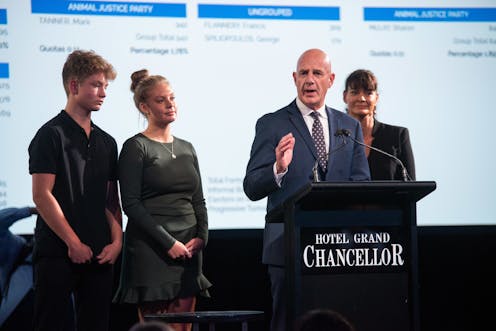
Premier Peter Gutwein had called this election ten months earlier than scheduled, hoping to take advantage of high ratings attributable to COVID. A June 2020 Newspoll gave Gutwein an astonishing rating of 90-8 satisfied, almost certainly the best approval polled by any premier or PM in Australian polling history.
Gutwein gambled that his COVID popularity would get the Liberals to a majority while it remained an issue. It looks as if his gamble has succeeded. The Liberals are likely to retain government in Tasmania for a third term, while the same party is in power federally. This is a big achievement in a state that voted for Labor by 56.0-44.0 at the 2019 federal election.
The last publicly released poll, an EMRS February poll, gave the Liberals 52%, Labor 27% and the Greens 14%. In my election preview, a uComms poll for The Australia Institute gave the Liberals 41.4%, Labor 32.1%, the Greens 12.4%, Independents 11.0% and Others 3.1%.
This commissioned poll was too low on the Liberals and too high on Labor and independents.
Liberals likely to gain Windermere in upper house, but Labor retains Derwent
Two of the 15 upper house seats were up for election for six-year terms. In Derwent, which Labor has held since 1979, they led the Liberals by 48.7% to 41.2%, with 10.0% for Animal Justice. In Windermere, held by a retiring conservative independent, the Liberals had 37.7% to Labor’s 26.8% with 21.2% for an independent.
Preferences have not yet been distributed for either seat, but Labor will clearly retain Derwent while the Liberals are likely to gain Windermere. The upper house will retain its 9-6 left-right split.
After first 100 days, Biden has 54% approval rating
It is 101 days since Joe Biden began his term as US president on January 20. In the FiveThirtyEight aggregate, his ratings with all polls are 53.9% approve, 41.4% disapprove (net +12.5%). With polls of likely or registered voters, Biden’s ratings are 53.8% approve, 42.0% disapprove (net +11.8%). For the duration of his presidency, Biden’s approval has been between 53% and 55%.
FiveThirtyEight has ratings of presidents since Harry Truman (president from 1945-53). At this stage of their presidencies, Biden’s net approval is only ahead of Donald Trump and Gerald Ford (who took over after Richard Nixon’s resignation in 1974).
The US economy, boosted by stimulus payments, appears to be recovering very well from COVID, but attempted illegal immigration has surged since Biden became president. The key question is how Biden’s ratings look at the November 2022 midterms, when the president’s party normally loses seats.
 Adrian Beaumont does not work for, consult, own shares in or receive funding from any company or organisation that would benefit from this article, and has disclosed no relevant affiliations beyond their academic appointment.