
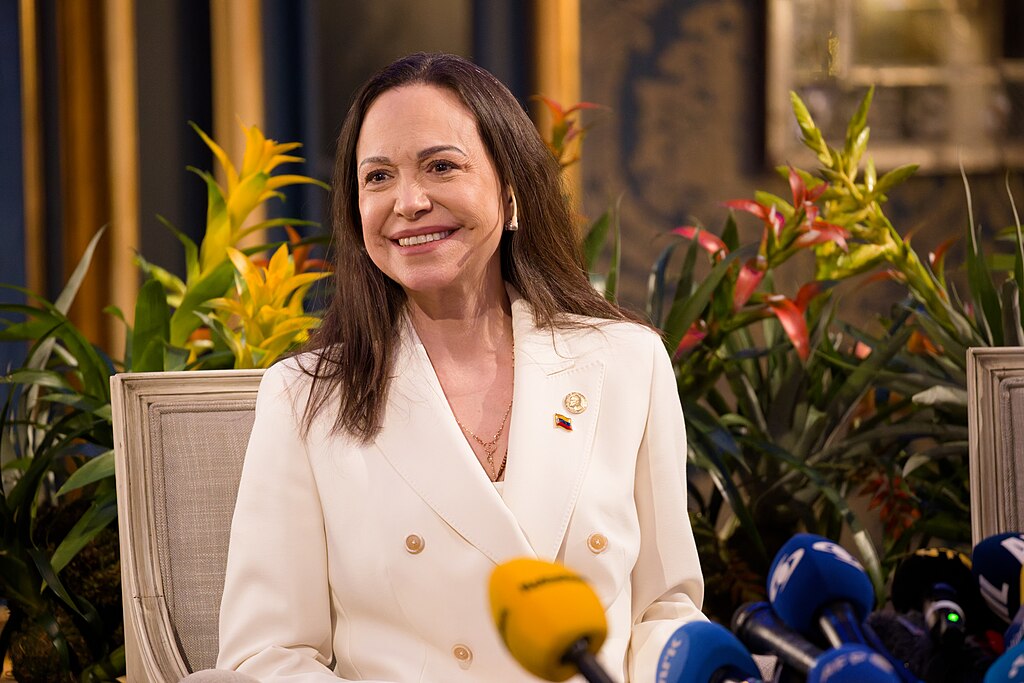
Venezuelan opposition leader Maria Corina Machado said on Thursday that she presented her Nobel Peace Prize medal to U.S. President Donald Trump during a recent meeting, a gesture that quickly drew international attention and sparked widespread discussion. Speaking briefly to reporters, Machado confirmed the presentation of the medal but declined to answer follow-up questions, including whether Trump formally accepted it.
The symbolic moment comes as Venezuela remains at the center of intense political, economic, and humanitarian challenges. Machado, a prominent figure in Venezuela’s opposition movement, has long positioned herself as a vocal advocate for democratic reform, human rights, and international pressure against authoritarian governance. Her reference to a Nobel Peace Prize medal underscores the global recognition she associates with her political struggle and her efforts to draw continued international engagement to Venezuela’s crisis.
According to Machado, the meeting with Trump took place on Thursday, though she did not provide additional details about the discussion, the setting, or the broader agenda. The lack of clarification on whether Trump accepted the medal has only fueled speculation, particularly given Trump’s past public comments on foreign policy, Venezuela, and international awards.
Political analysts note that the gesture may have been intended as a diplomatic signal rather than a formal transfer of an award. Presenting a Nobel Peace Prize medal, or referencing one, can be interpreted as a symbolic act aimed at emphasizing shared political goals or acknowledging perceived support. In this case, the moment highlights Machado’s strategy of engaging influential international leaders to keep Venezuela’s situation in the global spotlight.
Trump’s office has not issued an immediate response regarding the meeting or the reported presentation of the medal. As a result, questions remain about the significance of the exchange and whether it will have any practical impact on U.S. policy toward Venezuela.
Despite the unanswered questions, Machado’s statement has already generated strong reactions across social media and international news outlets, reflecting ongoing global interest in Venezuela’s opposition movement and its efforts to gain international backing during a critical period for the country.


