


 Japanese Yen Retreats as Dollar Rises Ahead of Fed, BOJ Rate Decisions
  Trump Demands Powell Resign Over Fed Renovation Cost Overruns
  Robinhood Stock Nears $114 as Jobs Data Boosts Risk Appetite
  ECB May Stop Rate Hikes After December, Capital Economics Says
  Coinbase, Visa Back Open USD Stablecoin Launch
  Fed’s Logan Signals 50 Basis Points More in Rate Hikes
  Evernorth Set for Nasdaq Debut With 473 Million XRP Treasury
  BlackRock’s Rick Rieder Favors Bonds Over Stocks as Treasury Yields Surge
  XRP Rises as Evernorth Merger Vote Clears Key Nasdaq Hurdle


 Add as a preferred source on Google
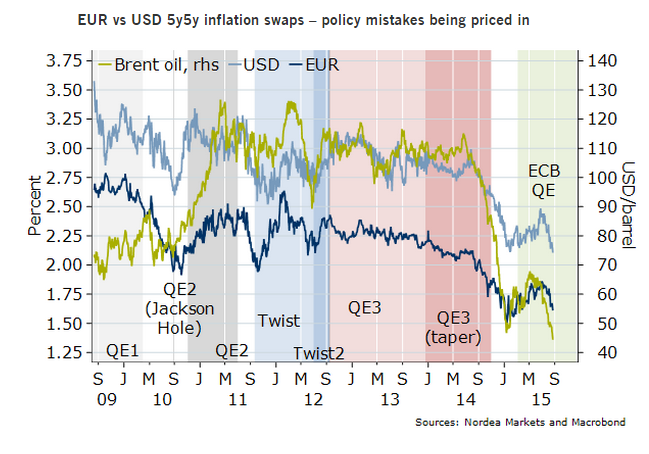
The ECB is faced with: i) a substantially stronger euro than expected, ii) inflation expectations are much below mandate-consistent levels, iii) oil prices are 31% lower than ECB expected in July, iv) GDP growth is looking a tad wobbly, and v) a market that is pricing in four successive deflation readings in coming months. The ECB will need to cut its inflation forecasts materially, which raises hopes for (EUR-negative) stimulus up ahead of the Sept meet.
In the euro area a number of prominent ECB members on the wires this week:
Tuesday: ECB Vice President Constancio speaks on 'Effects of non-standard monetary policy measures" in Mannheim, Germany (11:40 London time).
Wednesday: ECB Executive Board Member Praet speaks on "The Euro crisis and the role of different economic traditions' in Mannheim, Germany (11:40 London time).
Thursday: ECB Executive Board Member Coeure speaks at conference in Paris. (12:00 London time).
Their comments will be followed closely as the drop in the oil price is threatening the ECB's outlook for higher inflation and market-based 5Y5Y inflation expectations have declined below 1.7%. Around a year ago ECB president Draghi expressed concern when 5Y5Y inflation expectations declined below 2.0% and the latest decline could very likely result in a more dovish tone from the ECB.
With inflation so close to zero and several worrying signs from the world economy, this week's data will be interesting. After the surprising rise in July, the German Ifo index (0800 GMT Tuesday) is expected to fall slightly, driven mainly by China-related worries. Apart from that, Germany and Spain will be the first Euro countries to publish preliminary inflation prints for August.
"China and EM fears is currently triggering massive de-risking in global markets, leading to a substantial squeeze higher in EUR/USD. Inflation markets are currently screaming for both ECB and Fed to ease further. To us it makes sense for the ECB to "outdove" the Fed, but that depends on how much the central bank has changed under Draghi," Nordea Bank said in a report to its clients.
The single currency had set a seven-month peak of $1.1715 on Monday on panic triggered by China's stock markets crash. After bottoming out in the 1.1520 region, EUR/USD has managed to regain the 1.1560/70 band on the day.

- News

- Economy

- Central Banks
- Investing
- Research
- Roundups
- Digital Currency
- Insights
- Technical Analysis
- Technology
- Business
- Law
- Health
- Nature
- Fintech
- Science
- Topic
- Opinions
- ©Econometrics LLC . All Rights Reserved.
Oil price drop threatening ECB’s outlook for higher inflation, raising likelihood of a more dovish ECB
Tuesday, August 25, 2015 7:14 AM UTC
Editor's Picks



- Market Data
Most Popular




