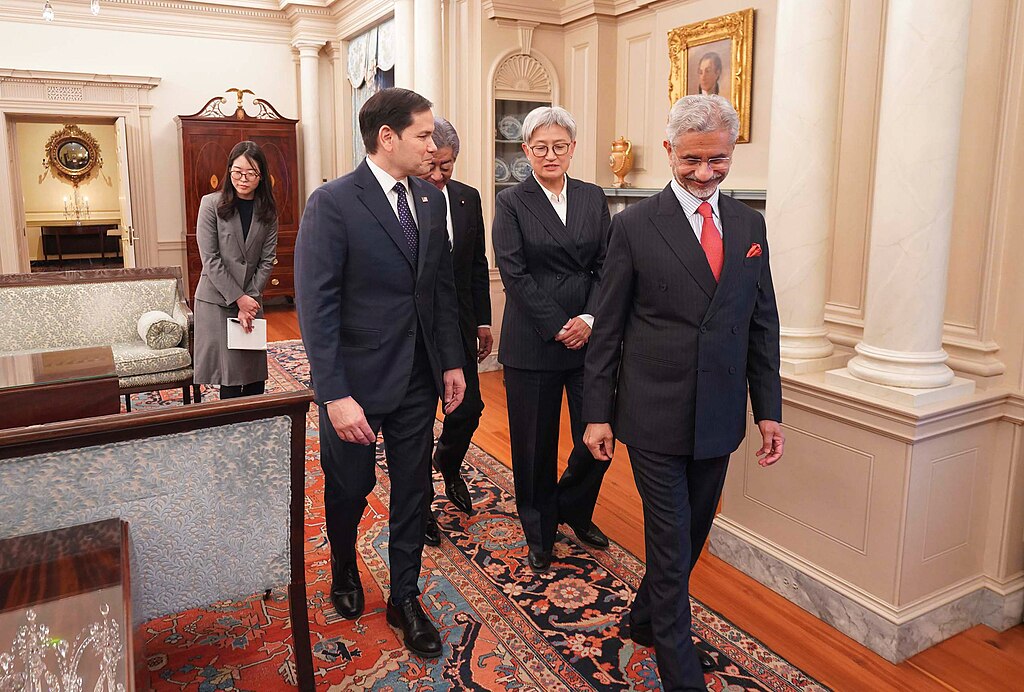
U.S. Secretary of State Marco Rubio will host foreign ministers from Australia, India, and Japan on July 1 to reinforce the Quad alliance and support a free and open Indo-Pacific, the State Department announced Thursday. This follows Rubio’s inaugural diplomatic meeting in January focused on countering China’s influence in the region.
“This summit builds on our commitment to peace, security, and prosperity in the Indo-Pacific,” said Deputy Spokesperson Tommy Pigott, emphasizing U.S. leadership under President Donald Trump’s second term.
The Quad—comprising the U.S., Japan, India, and Australia—has long been concerned about China’s growing assertiveness. In January, the ministers reaffirmed their commitment to regular coordination and laid the groundwork for a leaders’ summit in India later this year.
However, momentum has slowed due to escalating global conflicts and diplomatic friction. Trump’s attention has shifted toward conflicts in the Middle East and failed efforts to resolve the war in Ukraine. Meanwhile, his aggressive global tariff strategy has strained relations with Quad partners, who have not been exempted from new trade measures.
Concerns over unity deepened this week after key Indo-Pacific leaders, including the prime ministers of Japan and Australia, skipped the NATO summit in Europe. Further tension emerged when Japan reportedly canceled a bilateral meeting with the U.S. on July 1. According to the Financial Times, Tokyo reacted to demands by senior Pentagon official Elbridge Colby for increased defense spending—an issue that has also unsettled Australia due to ongoing reviews of its nuclear submarine project.
As Washington prepares for the July 1 Quad meeting, questions linger over the durability of its Indo-Pacific alliances amid mounting geopolitical and economic pressure.