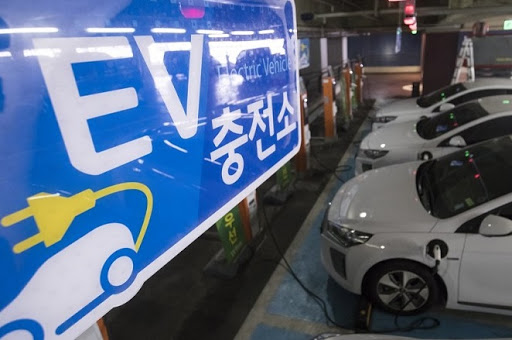
South Korea will ramp up efforts to promote a homegrown charging technology that allows electric vehicles to be charged up to 80 percent of their capacity within an hour as an international standard.
The country proposed the technology as a global standard to the International Electrotechnical Commission last year.
The Korean Agency for Technology and Standards recently held a virtual meeting with local and international experts to further foster the wireless charging technology for EVs with a capacity of 50 kilowatts.
The agency claimed the technology proposed by South Korea holds more potential than that suggested by Japan, whose charging capacity stands at 11 kW.
South Korea is also conducting studies that would allow cars to be charged while driving.
The technology is expected to be first applied on buses that run on fixed routes before being available in other automobiles. The agency believes the development can lead to stronger demand for EVs once commercialized.
South Korea plans to have eco-friendly cars, including hydrogen fuel cell cars, take up 30 percent of the total automobiles registered in the country by 2030, rising sharply from the current estimate of 3 percent.