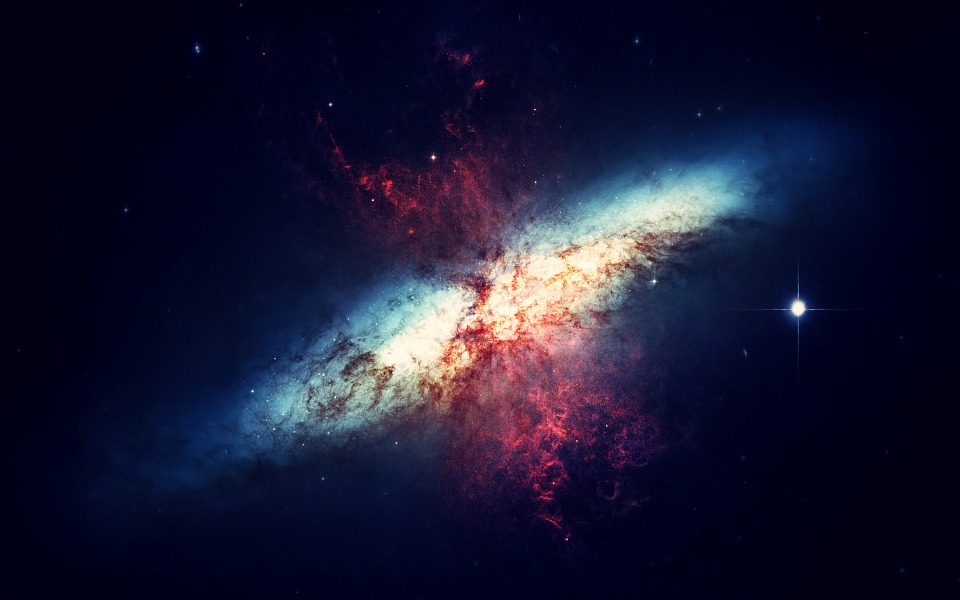
As far as space weather goes, many are aware of the solar storms produced by the sun emitting particles. But, scientists as of late, were able to witness a cosmic windstorm caused by a quasar.
Express reports that Western University Professor Sarah Gallagher witnessed the unusually strong winds that came from one particular quasar. Gallagher explained that quasars producing winds are a normal occurrence, but why this one is thought to be unusual is because they have never seen winds this intense coming from quasars. “While high-velocity winds have previously been observed in quasars, these have been thin and wispy, carrying only a relatively small amount of mass. The outflow from this quasar, in comparison, sweeps along a tremendous amount of mass at incredible speeds,” said Gallagher in a statement.
Gallagher also noted that it is unclear how this quasar in question, known as SDSS J135246.37+423923.5, was able to produce winds in high intensity. This quasar was first discovered by the Sloan Digital Sky Survey and was reexamined by scientists at the Hawaii-based Gemini North Telescope.
Quasars are created from supermassive black holes. These black holes accelerate certain kinds of particles that it cannot absorb. The winds that quasars produce intense wind speeds through the galaxy close by, reducing star formation.
The supermassive black hole this quasar orbits is predicted to have a mass that is over eight billion times than that of the sun. This would suggest that this black hole is 2,000 times the mass of the black hole within our galaxy.
Speaking of other discoveries, it was previously reported that the space object also known as Ouamuamua got its unusual shape after having collided with a distant star before hurtling through the Solar System. This would suggest that Ouamuamua may have been a part of a larger celestial object which was obliterated by another star within the Milky Way.
Should this be the reason why then it would explain how the active and enigmatic asteroid got its unusual shape and its behavior of moving away from the gravitational pull of the Sun so quickly. Researchers have called this behavior a tidal disruption.