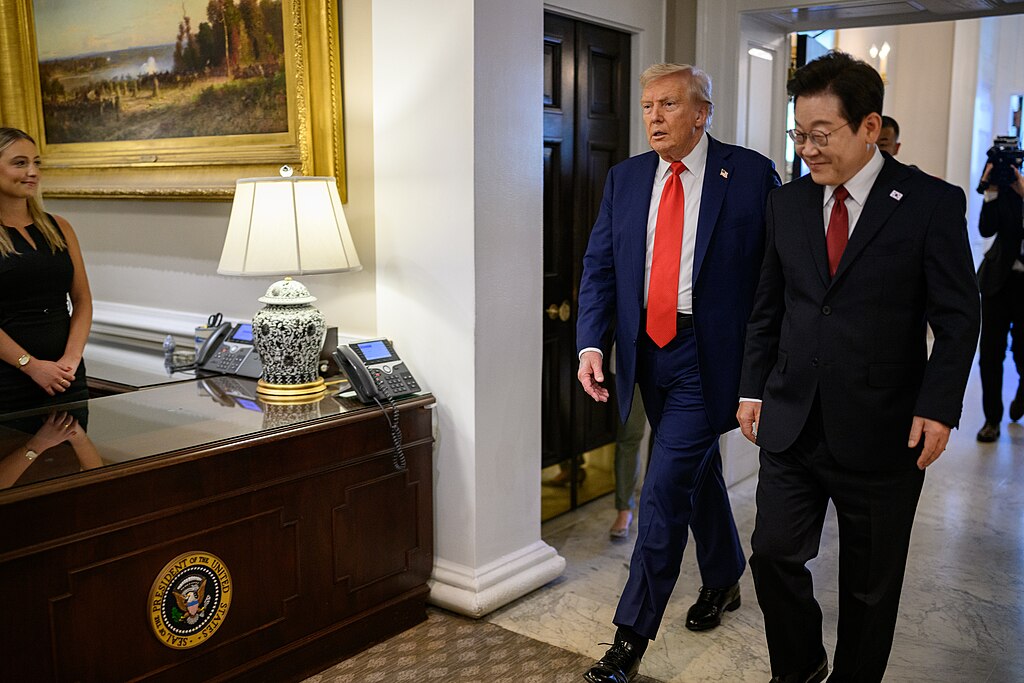
South Korean President Lee Jae Myung will meet U.S. President Donald Trump for the second time in two months on Wednesday, marking a pivotal moment for the 72-year U.S.–South Korea alliance. The two leaders are expected to discuss key issues including trade, defense costs, nuclear cooperation, and North Korea ahead of the Asia-Pacific Economic Cooperation summit in Gyeongju, which Trump is unlikely to attend.
Trade negotiations remain at an impasse as Seoul and Washington struggle to finalize a deal to reduce U.S. import duties on South Korean goods. The stalemate centers on a $350 billion investment pledge from South Korea, with Trump demanding the amount be paid “up front” in cash or equity. Seoul has proposed offering the funds primarily through loans and guarantees to support South Korean firms expanding in the United States, warning that a full cash payment could destabilize its financial markets.
Defense spending is another pressing issue. Trump has called on allies to pay significantly more for U.S. military presence and to raise defense budgets to 3.5% of GDP. South Korea currently spends 2.3% but plans an 8.3% increase in 2026—more than double this year’s rise. U.S. officials are also considering expanding the role of the 28,500 U.S. troops stationed in South Korea to address regional tensions involving China.
On nuclear energy, Seoul seeks revisions to a bilateral agreement allowing it to reprocess spent fuel and enrich uranium for civilian use. Meanwhile, discussions on North Korea remain complex. Although both nations agree on denuclearization, Trump’s remarks acknowledging Pyongyang as a “nuclear power” have raised concerns. President Lee remains committed to dialogue, viewing Trump as a potential bridge to Kim Jong Un, though North Korea has yet to respond.
Additionally, both sides aim to resolve issues surrounding U.S. work visas for South Korean employees after the recent arrests of hundreds of Hyundai workers, a move that shocked Seoul.