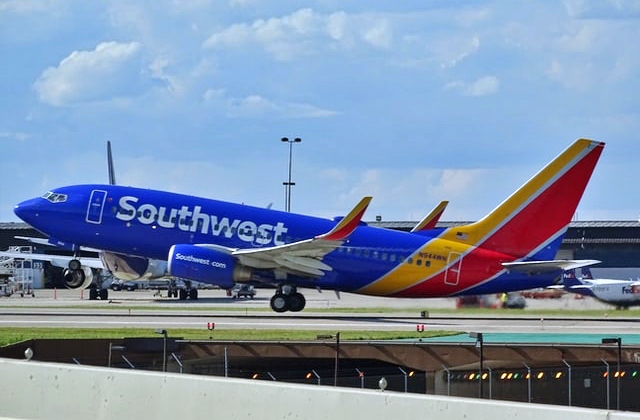
Southwest Airlines (NYSE:LUV) reported weaker-than-expected second-quarter earnings and revenue as subdued domestic travel demand and fare discounts pressured results. The Texas-based carrier posted adjusted earnings of $0.43 per share, below analyst expectations of $0.51, while revenue came in at $7.24 billion versus $7.29 billion forecast by LSEG.
Economic uncertainty tied to President Donald Trump’s trade war and rising living costs has dampened demand from price-sensitive U.S. travelers. Although leisure travel showed signs of recovery after a March-April slump, the company forecast third-quarter unit revenue — revenue per seat — to range from down 2% to up 2% year-over-year, reflecting continued volatility.
Southwest withdrew its full-year guidance in April and now projects 2025 earnings before interest and taxes at $600 million to $800 million, sharply below its prior $1.7 billion outlook. The airline has struggled to regain pre-pandemic momentum and recently overhauled its model by introducing checked-bag fees and a basic economy fare. While bag fees exceeded expectations, basic economy sales were weaker, weighing on revenue.
Competition from premium-focused rivals like Delta Air Lines (NYSE:DAL) and United Airlines (NASDAQ:UAL) has further pressured Southwest, whose customer base remains highly price-sensitive. Non-fuel operating costs are expected to rise up to 5.5% in the third quarter, while capacity will remain flat year-over-year.
Despite headwinds, Southwest noted early signs of improving demand industrywide. However, domestic pricing remains under strain as airlines cut fares to fill seats during the critical summer season. The company will provide further guidance during its analyst call on Thursday.