Electric vehicles and Self-driving cars is one of the biggest disruptions in the global economic landscape right now. EVs have the potential to shift the balance of power from crude oil to other sustainable sources of energy. Now, traditional automakers are working on building EVs and hybrids because EVs are here to stay. Self driving cars are also setting up shop to be a huge part of the future because self-driving cars will be more aware, make better driving decisions, and reduce instances of auto accidents.
As the development of self-driving cars continue to progress, many experts have predicted an end of the era of the auto insurance industry. In May, the legendary investor, Warren Buffet expressed fears that self-driving cars could hurt Berkshire Hathaway's auto insurance business. In his words, “If they (self-driving cars) make the world safer, it’s going to be a very good thing… but it won’t be a good thing for auto insurers.” This piece however provides insights into why such fears might be overblown.
The auto insurance is set to see a new burst of growth
When people start looking for auto insurance, they want a financial product that limits their liabilities in the event of an accident, destruction, or loss of their vehicles. Hence, even though self-driving cars might reduce the need for insurance against accidents; self-driving cars won't necessarily be immune from storm, hail, and flood damage. Self-driving cars might also be immune from outright theft – very people will be foolhardy or daring enough to steal a car that can be tracked by GPS in real time. Yet, self-driving cars would still be targets for a criminal who is intent on stealing wheels, CDs, and GPS systems among others.
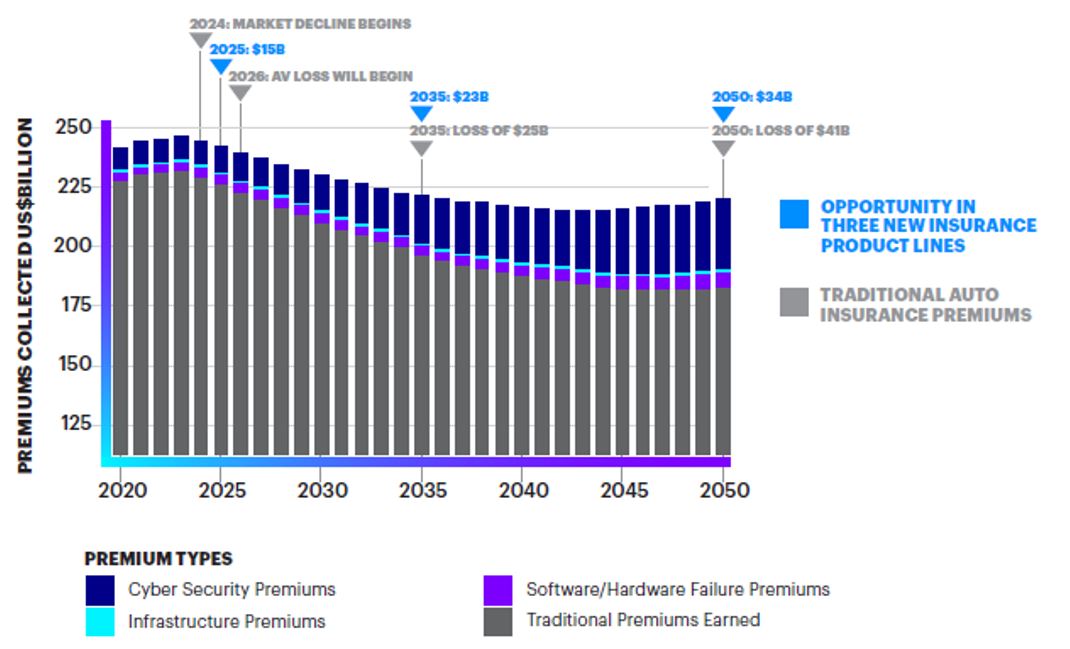
A new market research report from Accenture submits that the global auto insurance industry is on track to record massive growth in the future. In fact, the analysts at Accenture submit that the global auto insurance industry can book new insurance revenue of about $81 billion between 2020 and 2025. In the words of Accenture, "the threat posed to insurers by the rapid evolution of autonomous vehicles is real, but so is the $81 billion opportunity represented by new forms of insurance."
Self-driving cars have the potential to open up new classes of insurance products for the adaptive and proactive insurance firms as seen in the chart above. For instance, there will be need for insurance related to the cybersecurity risk of the AI infrastructure behind self-driving cars. Insurance firms will be able to offer insurance against "ransomware" that might render vehicles inoperable, hacking, and authorized access into the vehicle or its database.
Going forward, auto insurers can also provide policies that insure against hardware and software failure. Bugs, algorithm errors, memory overflow are some software weak points that could affect the smooth operation of self-driving cars. Errors in radar or LIDAR systems, faults in camera vision, and sensory circuit failures are some hardware weak points that could also trigger errors in the operation of self-driving cars.