
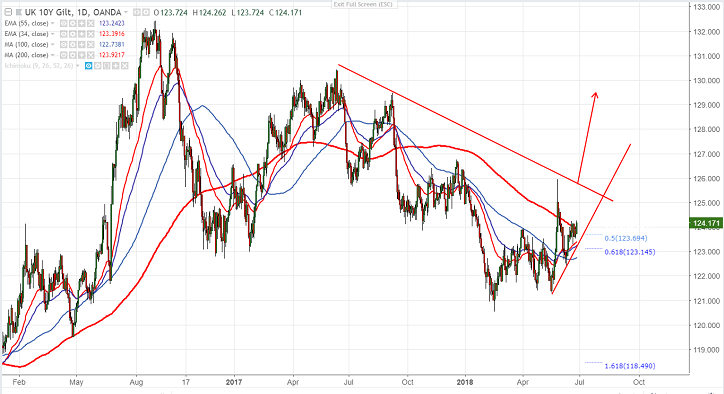
The UK’s benchmark 10-year gilt yield touched nearly 1-month low during mid-European session Wednesday after the Bank of England (BoE) acknowledged that Brexit poses the major tailwind for the country’s economic growth, in its Financial Stability Report (FSR) released now.
The yield on the benchmark 10-year gilts, slumped nearly 5 basis points to 1.25 percent, the super-long 40-year bond yields also plunged 5 basis points to 1.72 percent and the yield on the short-term 2-year traded 2 basis points lower at 0.72 percent by 09:30GMT.
The central bank said that domestic risks excluding Brexit remain standard overall but, however, judged that UK’s banking system could support the economy through a disorderly Brexit. In addition to that, he said that the country’s consumer credit growth remains 'rapid' and global risks are material and are increasing. Emerging markets, China debt, US leverage, and Italy are among those risks.
On June 20, the House of Commons voted down a clause that would have made the outcome of the Brexit negotiation process subject to Parliament's approval. In this way Parliament deprived itself of the opportunity to have the last say on Brexit. PM May thus once again secured her hold on power. The following day, the Bank of England's Monetary Policy Committee left the Bank Rate unchanged at 0.50 percent (as expected).
However, the decision was not taken unanimously. And this is precisely where the unexpected element lies: along with the two dissenters to date there is now a third MPC member in favour of raising the Bank Rate. Moreover the BoE made a change to its guidance: having previously talked of not considering commencing the sale of its stock of bonds until a key-rate level of 2.00 percent, they now lowered this threshold to 1.5 percent.
"A further step towards the normalization of monetary policy could thus begin a bit earlier. The door is open for an August hike – but a renewed decision to wait would also be possible. We expect sterling to depreciate," NORDLB Research commented in its latest report.
Technical Analysis: 10-year gilt prices are facing a 61.8% Fib retracement at 123.145 and 50% retracement at 123.694 – S1 and S2 respectively. Any break below the S2 will see markets drifting away from safe-haven buying and a further upside above 125.00 could call for caution for risk-taking sentiments.
Meanwhile, the FTSE 100 traded 0.04 percent lower at 7,534.25 by 09:45GMT, while at 09:00GMT, the FxWirePro's Hourly Pound Strength Index remained neutral at -54.73 (a reading above +75 indicates a bullish trend, while that below -75 a bearish trend). For more details, visit http://www.fxwirepro.com/currencyindex

