
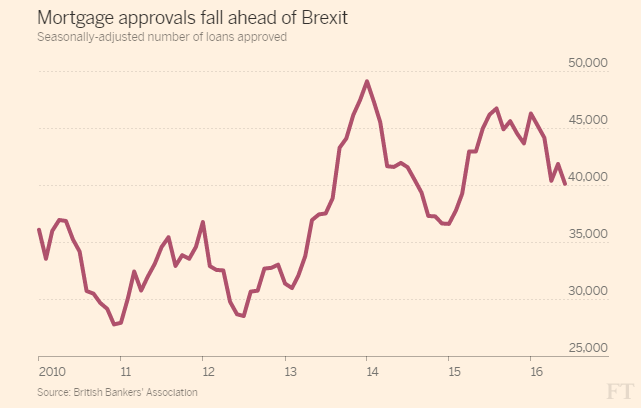
The British Bankers' Association (BBA) data released earlier today showed that British banks approved the fewest mortgages for house purchase since March 2015 in June. The number of mortgages approved by British banks last month dropped to 40,103 from May's downwardly revised 41,842, the BBA said. The fall was slightly less than analysts' forecast, but still the lowest figure since last March.
The value of net mortgage lending dropped to 1.399 billion pounds in June from 1.665 billion, though it was well above a low of 208 million pounds struck in April after a new tax was imposed on purchases of second homes and rental properties. The increase in stamp duty caused a sharp drop in approvals in April, but the latest decline was more likely due to Brexit after numbers briefly recovered in May.
The BBA figures do not include lending by mutually owned building societies, which accounts for around a third of mortgages. Bank of England's lending data due on Friday would provide a more comprehensive view. UK house price data is due this Thursday and reports suggest prices of residential real estate in the London area have fallen sharply over the past month.
"The sharp decline in surveys of house price expectations and profit warnings from estate agents since the vote, however, signals that mortgage demand has fallen further in recent weeks. Meanwhile, little scope remains for mortgage rates to decline further and so revive demand," notes Samuel Tombs, chief UK economist at Pantheon.
The Bank of England surprised markets earlier this month when it opted to keep interest rates at 0.5 percent when many had speculated the rate would be cut to calm the markets following the Brexit vote. Meanwhile, MPC member Weale's comments earlier today make stimulus measures at the next Bank of England's Monetary Policy Committee (MPC) meet more likely.
MPC member Weale, who last week voiced some opposition to the dovish signals from Carney (and the minutes), said UK flash PMIs convinced him of the need for immediate monetary support. Weale's comments follow a string of weak data for the economy. Last week, Markit's UK purchasing managers' index (PMI) indicated the economy had contracted at its steepest pace in around seven years. Monday's CBI industrial trends survey showed manufacturers' concerns for the future following Brexit vote.
GBP/USD edged lower following Weale's comments to hit session lows of 1.3057, but recovered to trade almost unchanged on the day at around 1.3126 at 12:00 GMT. EUR/GBP was trading at 0.8377, up 0.14 percent on the day.


