


 Yen in Focus as BOJ, Fed Rate Hikes Reshape Currency Markets
  Kazakhstan and Tether Explore Tenge Stablecoin and RWA Tokenization
  RBI Raises Repo Rate to 5.50% in Hawkish Shift on Inflation Risks
  Fairshake Backs 32 Pro-Crypto House Candidates
  Oil Prices Rise as Hormuz Attacks Fuel Supply Fears
  Asian Currencies Steady as Dollar Holds Near 18-Month High
  Sector Spotlight: Data Availability and Storage Lead 24-Hour Market Gains
  BofA Raises Coinbase Stock Target to $203 on Stablecoin Growth
  Cardano Price Surges 10% as ADA Targets $0.30
  Oil Prices Rise as Hormuz Risks Offset IEA Stock Release
  US Dollar Hits 18-Month High as Fed Signals More Rate Hikes
  Fed’s Logan Signals 50 Basis Points More in Rate Hikes
  Fed’s Hammack Says Bond Yield Surge Is Not Driven by Inflation Fears


 Add as a preferred source on Google
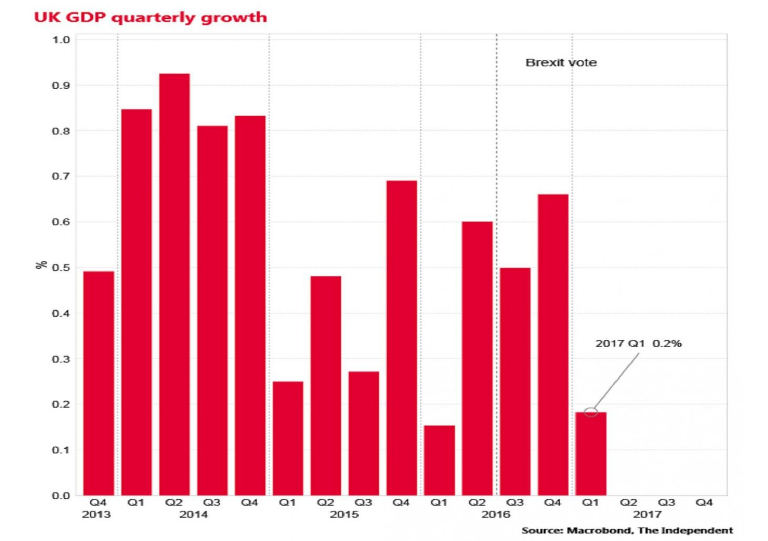
The second estimate of UK GDP for Q1 2017 released earlier today saw an unexpected revision down to 0.2 percent from the previous estimate of 0.3 percent. Today's data follows growth of 0.7 percent in Q4 of 2016 and means that the UK's growth slowdown - partly driven by rising inflation - is worse than initially thought. The estimate missed consensus in Reuters’ poll for an unchanged reading.
The expenditure breakdown for Q1 showed that consumer spending continued to be a key driver of economic growth, although its contribution to growth was lower than in Q4. The Office for National Statistics (ONS) said the dominant services sector - which represents more than three quarters of output - had been weaker than anticipated.
The overall contribution to growth from net exports was negative (-1.4 percentage points) in Q1 confounding expectations of a boost to export growth from the post-referendum decline in sterling, raising some doubts over the extent to which the UK economy can rebalance itself in the face of weaker consumer trends. The figures provide the latest evidence that the early resilience to the EU referendum result last June is now wearing off.
The Q1 outturn moves further away from the Bank of England’s (BoE) assumed growth rate of 0.4 percent q/q. UK's economic growth was well below the 0.6 percent q/q average pace recorded in the second half of 2016. That said, recovery in retail sales and the PMIs for April support expectations of a recovery in the pace of growth in Q2.
"More recent business surveys suggested there was a good chance growth could rebound in the second quarter," said Ruth Gregory, UK economist at Capital Economics.
BoE’s rate setting committee will likely be more focused on economic growth trends for the rest of the year. Despite many challenges ahead, analysts feel any slowdown this year will not be too severe. "Data is unlikely to have a significant impact on the thinking of the majority of the BoE’s rate setting committee," said Lloyds Bank in a report.
Cable declined after showing a minor jump above 1.3000 after the weaker-than-expected UK GDP data. Major support is around 1.2930-40 (10 day MA and 20- day MA) and any break below will drag the pair down till 1.2900/1.2830. On the higher side, any close above 1.30500 confirms bullish continuation and a jump till 1.3088/13120 likely.
FxWirePro's Hourly GBP Spot Index was at -53.0841 (Neutral) and Hourly USD Spot Index was at -3.94569 (Neutral) at 1130 GMT. For more details on FxWirePro's Currency Strength Index, visit http://www.fxwirepro.com/currencyindex.







