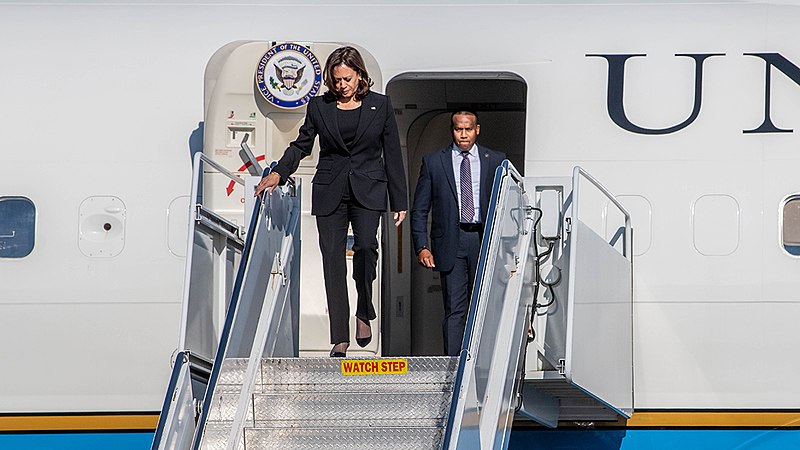
United States Vice President Kamala Harris visited the Philippines as part of her Asia trip this week. In her visit to Manila, Harris stressed the US commitment to its longtime defense treaty ally.
Harris stressed Washington’s commitment to the Philippines in her visit to the former US colony, the highest-ranking US official since President Ferdinand Marcos Jr. took office. During talks at the presidential palace in the capital, Harris reaffirmed US support, especially related to matters on the South China Sea. The Philippines is one of the countries in the region with claims to the contested waters.
“We stand with you in defense of international rules and norms as it relates to the South China Sea,” Harris told the Philippine leader. “An attack on Philippine armed forces, public vessels or aircraft in the South China Sea would invoke the US mutual defense commitment…that is our unwavering commitment to the Philippines.”
Marcos said he did not “see a future for the Philippines that does not include the United States.”
During her three-day visit, Harris is also set to visit Palawan, the island on the edge of the South China Sea, and will reaffirm the US support for the 2016 tribunal that ruled in favor of the Philippines, rejecting China’s claim of sovereignty over most of the body of water. Beijing has rejected the ruling and has continued to assert its claim through artificial islands.
Harris’s visit also comes as Washington also seeks to bolster its security alliance with the Philippines as relations soured during Marcos Jr.’s predecessor Rodrigo Duterte’s administration, as Duterte sought closer ties with China.
Palawan is around 320 kilometers from the Spratly Islands, where China has dredged the sea floor to build its artificial islands. In Palawan, Harris is also set to visit a fishing village and tour a Philippine Coast Guard vessel, according to a US official.
Around the same time as Harris’s visit, the Philippine military commander said a Chinese coast guard “forcefully retrieved” an object that was being towed by a Philippine vessel in the South China Sea.
The US and the Philippines have moved forward with the Enhanced Defence Cooperation Agreement that dates back to the Obama administration. The EDCA agreement would allow the US to maintain a military presence but not a permanent one.