
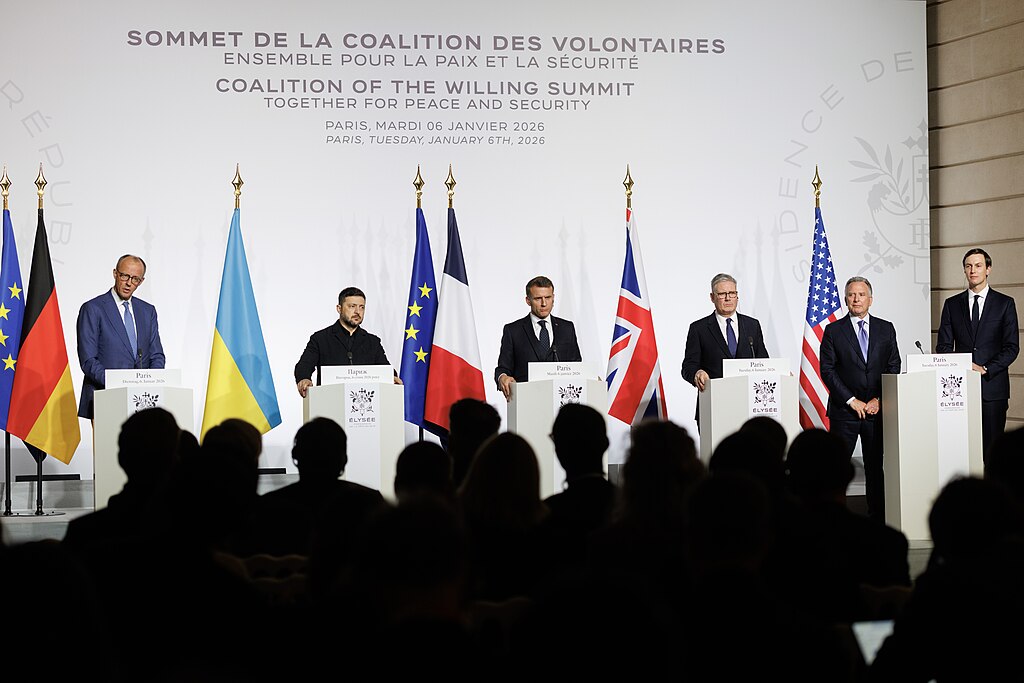
The United States and key European nations have moved significantly closer to finalizing legally binding security guarantees for Ukraine, aimed at preventing renewed Russian aggression once a future peace agreement is reached. Following high-level talks in Paris, leaders emphasized that lasting peace in Ukraine must be backed by strong deterrence, defense mechanisms, and long-term reconstruction support.
U.S. Special Envoy Steve Witkoff said Washington stands firmly behind the proposed security protocols, describing them as among the strongest ever developed. According to Witkoff, the guarantees are designed both to deter future attacks and to defend Ukraine if violations occur. He added that discussions on security arrangements are largely complete and are being paired with what he called an exceptionally robust post-war prosperity agreement to support Ukraine’s recovery.
Jared Kushner, son-in-law of U.S. President Donald Trump, described the Paris meeting as a major milestone. While cautioning that peace is not guaranteed, he stressed that progress on security guarantees is essential for any final deal, ensuring Ukraine has credible deterrence and reliable backstops after a settlement.
European leaders echoed these sentiments. British Prime Minister Keir Starmer said the declaration lays the groundwork for a legal framework allowing British, French, and partner forces to operate in Ukraine after a ceasefire, helping secure airspace and maritime routes while rebuilding Ukraine’s armed forces. French President Emmanuel Macron emphasized that the guarantees are meant to ensure peace does not equate to Ukrainian surrender. He clarified that potential multinational deployments would not be combat forces but peace-support units activated after an agreement.
Ukrainian President Volodymyr Zelenskiy said detailed plans are already in place, covering land, air, sea security, command structures, and reconstruction. He confirmed that bilateral and trilateral security documents involving Ukraine, the United States, and partners are ready for signing soon.
German Chancellor Friedrich Merz and Polish Prime Minister Donald Tusk highlighted continued political, military, and diplomatic support, stressing the need to encourage Russia to engage seriously in peace negotiations.


