On Thursday May 4, for the first time, members of the public voting in local council elections in England were required to bring photo ID to their polling station. Initial reports suggested that a few people were turned away because they didn’t bring one of the approved forms of photo ID.
But even if they did bring the right documents, such as a driving licence or passport, there’s a question mark over whether the people manning polling stations could tell accurately whether the voter was the person pictured in the ID.
When you present your photo ID to be checked, the person looking at it has to decide if your face matches the picture in the document. In a lab, this is usually done with images and is called “face matching”. Such studies typically present two face images side-by-side and ask people to judge whether the images show the same person or two different people.
While people perform well at this task when they are familiar with the person pictured, studies report the error rate can be as high as 35% when those pictured are unfamiliar. Even when people are asked to compare a live person standing in front of them with a photo, a recent study found they still got more than 20% of their answers wrong.
Natural ability
The people checking our photo ID are almost always unfamiliar with us, so we should expect that this is a difficult, error-prone task for them. And while you might think that people whose job it is to check photo ID would be better at it than the rest of us, cashiers, police officers and border control officers have all been shown to be as poor at face matching as untrained people.
The study of border control officers also showed they don’t improve at the task as time goes on – there was no relationship between their performance and the number of years they had spent in the job.
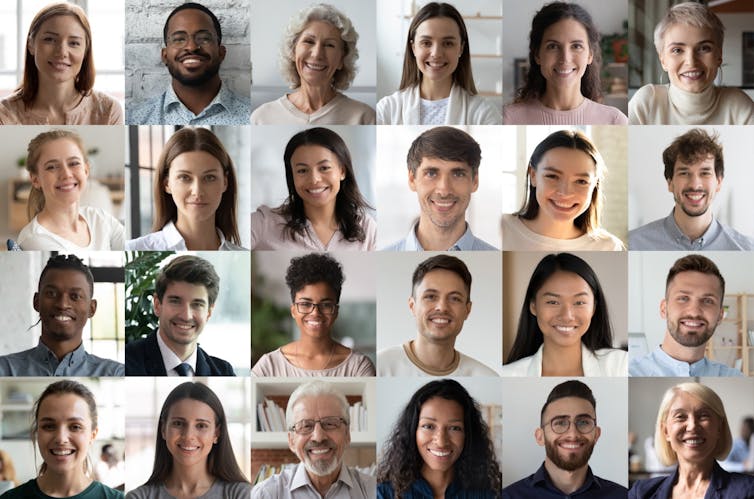
Few people are good at matching photos to a real face. fizkes / Shutterstock
This suggests that face recognition ability doesn’t change with practice. While repeated exposure to variable images of one person’s face can help you to recognise them, professional facial image comparison courses aimed at training face identification ability have not been shown to produce lasting improvements in performance.
There is, however, an argument for the role of natural ability in face recognition. People known as “super-recognisers” perform far better than the general population at tests of face recognition, and have been used by police forces to identify criminals.
For example, super-recognisers could be asked to look through images of wanted persons and then try to find them in CCTV footage, or match images caught on CCTV to police mugshots. Some of us are just better than others at these types of task.
Error-prone task
But why is it so difficult for most of us to recognise an unfamiliar person across different images? We all know that we look different in different pictures – not many of us would choose to use our passport image on a dating website. And this variability in appearance is what makes unfamiliar face matching so difficult.
When we are familiar with someone, we have seen their face many times looking lots of different ways. We have been exposed to a high amount of this “within-person variability”, enabling us to put together a stable representation of that familiar person in our minds.
Super-recognisers could be asked to look through images of wanted persons and search for them in CCTV footage. engel.ac / Shutterstock
In fact, exposure to within-person variability has been shown to be crucial for learning what a new face looks like. With unfamiliar people, we just haven’t seen enough of their variability to reliably decide whether they look like the image in their photo ID.
Photo ID at elections
Here’s what this means for photo ID at elections, which was introduced as an attempt to tackle voter fraud. In fact, aside from the issue of people not having the required form of photo ID in order to vote, having people at polling stations check photo ID may not actually be a reliable way of verifying voters’ identities.
People could be falsely matched to an incorrect ID, or incorrectly turned away on the basis that they don’t match the photo in the document. Unfamiliar face matching is error-prone, and can’t be reliably trained.
So, unless the people at the polling stations are super-recognisers, they may find it difficult and make errors when matching voters to their photo IDs.