


 TSMC Q2 Revenue Surges 36% as AI Chip Demand Powers Growth Ahead of Earnings
  DeepSeek Eyes China IPO as AI Startup Seeks $71 Billion Valuation in New Funding Round
  Australia Flags Child Safety Gaps at Apple, Meta, Google Over Online Sexual Extortion
  Arm Stock Falls After HSBC Downgrade, Citing Limited Near-Term AI Upside
  Chinese Chip Stocks Jump as Apple Reportedly Tests CXMT Memory Chips for China Devices
  Elon Musk Says Anthropic Leads AI Race as Claude Models Challenge OpenAI
  ASML Raises 2026 Outlook as AI Chip Demand Lifts Q2 Earnings
  SK Hynix’s $28B U.S. IPO Draws Strong Demand as AI Chip Boom Fuels Investor Interest
  Nvidia Invests $500M in Firmus Technologies Ahead of Planned ASX IPO
  SK Hynix Prices Record U.S. ADR Offering at $149 After $200 Billion Investor Demand
  EU to Propose New Rules Limiting Children's Access to Social Media
  Apple Sues OpenAI, Former Employees Over Alleged Trade Secret Theft
  Yaskawa Electric Shares Slide as Weak Profit Overshadows Strong AI Demand
  Zhipu AI Raises HK$31.37 Billion in Discounted Share Sale to Accelerate AI Growth
  SoftBank Corp Partners With Sierra to Expand AI Customer Support Across Japan
  Samsung to Launch First Yongin Chip Plant by 2029 as South Korea Speeds Up Semiconductor Hub


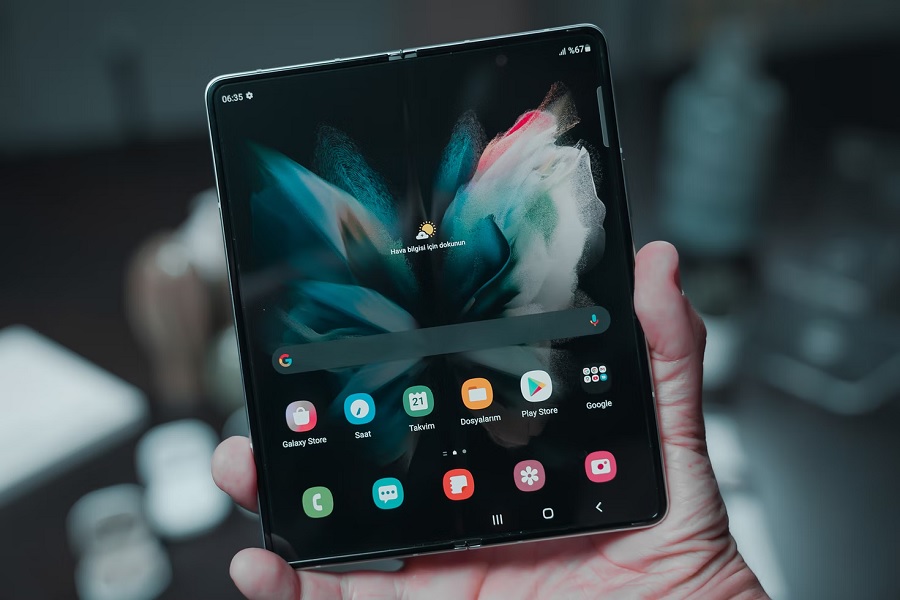
Samsung quietly applied a small change to the name of its foldable Galaxy phone in a few European countries. The company has yet to explain the subtle rebranding, but there are speculations that it could be related to the ongoing war between Russia and Ukraine.
A few people online started noticing on Tuesday that Samsung’s Galaxy Z Fold 3 pages on its regional online stores for Estonia, Latvia, and Lithuania dropped the letter “Z” from the device’s name. Some find the discreet change a little surprising, but it is also possibly a timely decision.
Tech enthusiast and known leaker Ishan Agarwal suggested that the slight change could be due to the letter “Z” recently becoming a symbol of support for Russia’s military actions in Ukraine.
Samsung has removed the ‘Z’ from its phones in certain European countries.
— Ishan Agarwal (@ishanagarwal24) March 29, 2022
Z Fold/Flip3 are being sold as just Galaxy Fold3/Flip3.
Change could be due to symbol ‘Z’ representing Russian Army during the ongoing invasion in Ukraine. New retail boxes have been printed as well. pic.twitter.com/RvadGYN0Xi
Russia launched a large-scale attack on Ukraine last Feb. 24. A ceasefire agreement has yet to be signed, but Reuters reported on Tuesday that Russia agreed to scale down its attacks on Ukraine’s capital, Kyiv, following the latest round of negotiations in Istanbul.
Weeks into the armed conflict, supporters of the Russian government and its moves on Ukraine have started using the letter “Z” as a sign of support online and on the streets. It is not fully clear how that came to be, but several reports pointed out that hand-painted “Z” were spotted on Russian tanks that were amassed at the Ukrainian borders before the attacks commenced last month.
Again, it should be noted that Samsung has not offered an official explanation yet as to why the rebranding is only currently seen on its websites in Estonia, Latvia, and Lithuania. Samsung online stores for other European markets, like Poland, still call the foldable phone Galaxy Z Fold 3.
Samsung is reportedly working on applying the name change beyond its online stores. “New retail boxes have been printed as well,” Agarwal said.
Whether or not it is related to the current geopolitical crisis, other tech fans have welcomed the rebrand for other reasons, saying “Galaxy Fold” and “Galaxy Flip” are better names for their simplicity. Samsung originally used the “Galaxy Fold” name in 2019, but announced the following year that its foldable phone lineup would be officially called “Galaxy Z.” Samsung told Bloomberg in 2020 (via XDA), “We chose ‘Z’ for this series because it intuitively communicates the idea of a fold while delivering a dynamic, youthful feel.”
Photo by Onur Binay on Unsplash







