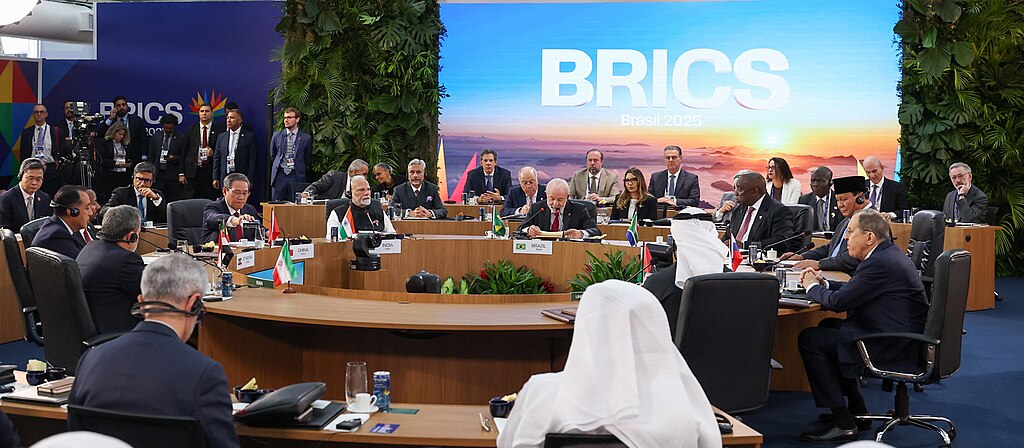
The BRICS summit in Rio de Janeiro marked a pivotal moment for the expanding group of developing nations as leaders condemned Israeli attacks on Gaza and strikes on Iran, while advocating for reforms in global governance. With the G7 and G20 hampered by internal divisions and U.S. President Donald Trump's "America First" approach, BRICS is positioning itself as a platform for multilateral diplomacy.
Brazil’s President Luiz Inacio Lula da Silva emphasized BRICS as a modern-day heir to the Cold War’s Non-Aligned Movement. With its expanded membership—including Egypt, Ethiopia, Indonesia, Iran, Saudi Arabia, and the UAE—the bloc now represents over half the global population and 40% of the world’s GDP.
Despite the growing influence, internal complexity is rising. Chinese President Xi Jinping did not attend in person, and Russia’s Vladimir Putin joined online due to an ICC arrest warrant. Still, key figures like Indian Prime Minister Narendra Modi and South Africa’s President Cyril Ramaphosa were present, alongside Indonesia’s President at his first summit.
BRICS leaders jointly criticized violations of international law targeting Iran’s nuclear infrastructure, voiced concern over Gaza, and condemned terrorism in Kashmir. They also opposed rising global tariffs and supported WTO membership for Ethiopia and Iran. The bloc urged urgent reforms to the UN Security Council and the IMF, aligning with Lula’s call for a new global order.
The group backed a BRICS Multilateral Guarantees initiative via the New Development Bank to lower investment costs and pledged responsible development of AI technologies.
With over 30 countries showing interest in joining, BRICS is asserting itself as a leading force for the Global South—promoting trade, peace, and climate action, including support for Brazil’s proposed Tropical Forests Forever Facility.