Curious Kids is a series for children. If you have a question you’d like an expert to answer, send it to curiouskids@theconversation.edu.au You might also like the podcast Imagine This, a co-production between ABC KIDS listen and The Conversation, based on Curious Kids.
My name is Abhilasa. I am 10 years old and I live in Melbourne. My question is: Why are people colour blind? – Abhilasa, age 10, Melbourne.
Hi Abhilasa. Thank you for your great question.
Let’s say you have three tubs of paint: blue, green and red. You have a paintbrush and a piece of paper. You can use the three paints to make lots of different things. A green tree, a blue car, or a red apple. And if you want to paint a purple shirt, you can mix red and blue paint to make purple.
How do we see those different colours? In your eye you have special kinds of cells that pick up the light rays bouncing off each splotch of paint. These cells are called cone cells.
In the microscope, they look like ice-cream cones. But they are much smaller. The cone cells help you see the different colours.
There are three kinds of cone cell in most people’s eyes. They are called long wave cones, medium wave cones, and short wave cones, because they pick up different kinds of light waves (or rays).
The cone cells tell the brain how much of each type of light wave is bouncing off each splotch of paint.
Your brain puts those messages back together again.
So let’s say you mix red and blue paint to make a purple splotch. Lots of long and short wave light will bounce off that splotch, but not much medium wave light will (the reason this happens is hard to explain, but you just have to trust me that this is how light works). Then the long and short cones in your eyes get activated, and will send their message to the brain. The brain interprets the message and voilà! The splotch will look purple to you.
Colour blind people can still can see colours, but not as many as most people do. That’s because the cone cells in their eyes may be different.
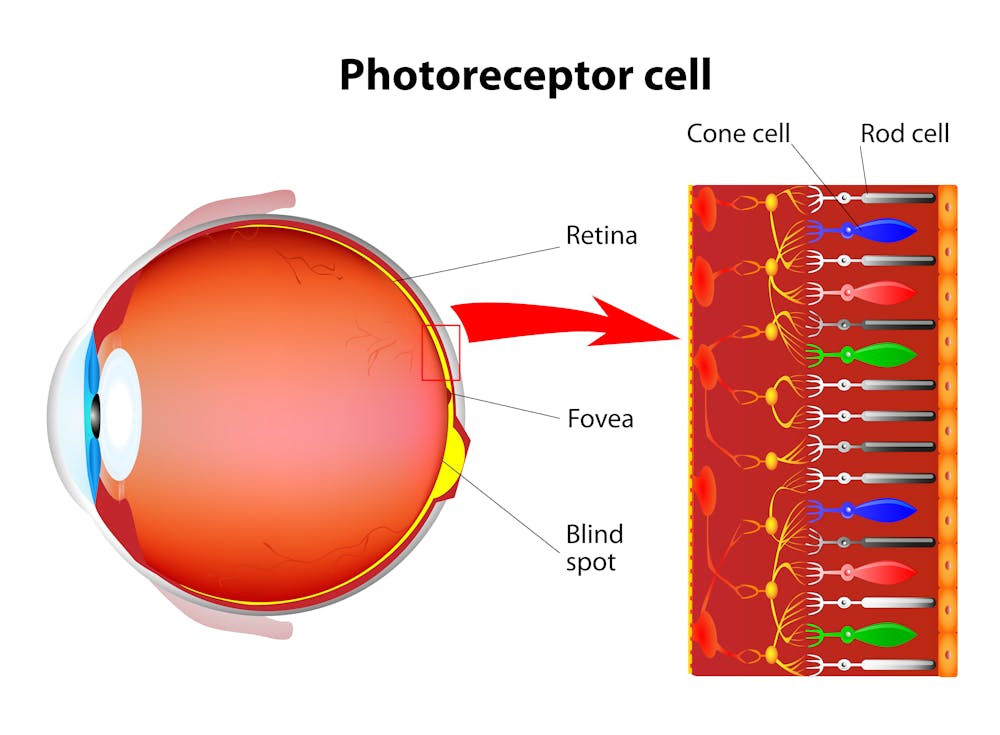
There are three kinds of cone cells in most people’s eyes. Shutterstock
Some colour blind people only have two kinds of cone cell in their eye. Others have three kinds, but the cones do not pick up the same light waves as the cone cells in most people’s eyes do. So their brain does not get three different messages like most people’s brains do.
Being colour blind is a bit like what would happen if I took away one of your tubs of paint, so you only have two tubs. You could still make some different-coloured splotches, but not as many as when you had three tubs. That would not be so much fun. Being colour blind is sometimes not much fun either. Some kids laugh in school when colour blind kids get their coloured pencils mixed up. That’s mean.
But being colour blind can be good, too. Colour blind people are really good at spotting things that are far away, and they are better than most people at telling things apart by their shape.

Please tell us your name, age and which city you live in. You can send an audio recording of your question too, if you want. Send as many questions as you like! We won’t be able to answer every question but we will do our best.