


 Visa Wins China Approval to Prepare Domestic Payments Expansion
  FxWirePro: Daily Commodity Tracker - 21st March, 2022
  BlackRock’s Rick Rieder Favors Bonds Over Stocks as Treasury Yields Surge
  IMF Maintains 2027 Global Growth Forecast at 3.4% Amid Rising Risks
  Asian Stocks Plunge as AI Chip Selloff Hits South Korea and Japan
  Philippines Current Account Deficit Seen at $19.1 Billion in 2026
  Oil Prices Rise as Houthi Attacks Threaten Middle East Supply
  Gold Prices Rise Above $4,200 as Russia-Ukraine Energy Truce Eases Oil Concerns
  Fed’s Hammack Says More Data Needed Before Next Rate Move
  Asian Currencies Steady as Dollar Nears 18-Month High Ahead of US CPI
  Oil Prices Fall as Trump Ceasefire Claim Shifts Market Focus to U.S. CPI
  Trump Demands Powell Resign Over Fed Renovation Cost Overruns
  Fed’s Williams Signals One More Rate Hike Before Year-End


 Add as a preferred source on Google
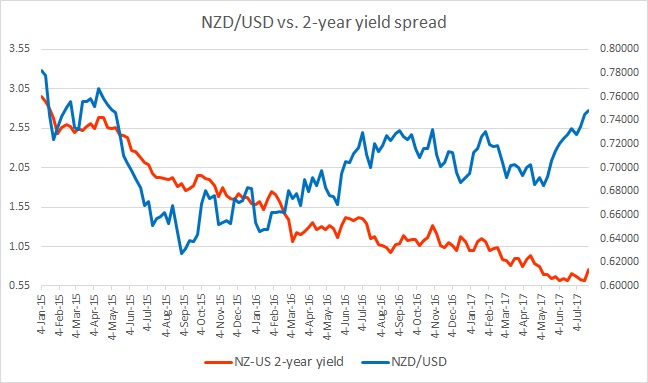
The chart above shows, how the relationship between NZD/USD and 2-year yield divergence has unfolded since 2015.
- The close relations between the short-term yield spread and the exchange rate is quite visible also the big divergence with it.
- While the Reserve Bank of New Zealand (RBNZ) reduced rates after the financial crisis of 2008/09, it somewhat increased interest rates due to higher commodity prices and higher inflows from other western economies. It raised rates by 50 basis points to 3 percent in 2010, only to reduce it again to 2.5 percent in early 2011. In 2014, it increased rates by 1 percent to 3.5 percent and started reducing rates again beginning June 2015. The rates steadily declined from 3.5 percent to 1.75 percent by November 2016, when it signaled a halt.
- It can be seen from the chart that New Zealand dollar declined from 0.78 against the dollar in January 2015 to 0.62 by August, while the yield spread declined from 296 basis points to 192 basis points.
- However, there has been divergence since then. Between now and the August 2015, the RBNZ reduced rates further by 100 basis points, while Fed raised rates by 100 basis points. The yield spread also declined from 190 basis points to just 76 basis points. However, the NZD/USD didn’t make further low, instead, it has moved higher from 0.628 in August 2015 to 0.75 as of today. The divergence is very high, as of now.
- We believe, that expectations of a rebound in commodities as well as New Zealand economy are playing parts here. However, sooner or letter the du0 would have to converge, which we expect would come in terms of rate hikes from RBNZ and increase in the spread in favor of the New Zealand dollar.
FxWirePro launches Absolute Return Managed Program. For more details, visit http://www.fxwirepro.com/invest







