


 Fed Unveils Stablecoin Rules Under GENIUS Act
  Fed’s Hammack Says Bond Yield Surge Is Not Driven by Inflation Fears
  UBS Projects Mixed Market Outlook for 2025 Amid Trump Policy Uncertainty
  2025 Market Outlook: Key January Events to Watch
  Fed May Resume Rate Hikes: BofA Analysts Outline Key Scenarios
  UBS Predicts Potential Fed Rate Cut Amid Strong US Economic Data
  Wall Street Analysts Weigh in on Latest NFP Data
  Philippines Current Account Deficit Seen at $19.1 Billion in 2026
  Oil Prices Dip Slightly Amid Focus on Russian Sanctions and U.S. Inflation Data
  US Gas Market Poised for Supercycle: Bernstein Analysts
  Lithium Market Poised for Recovery Amid Supply Cuts and Rising Demand
  RBA Says ASX Still Falls Short on Governance and Risk Controls
  RBI Rate Hike Bets Surge as Inflation Rises


 Add as a preferred source on Google
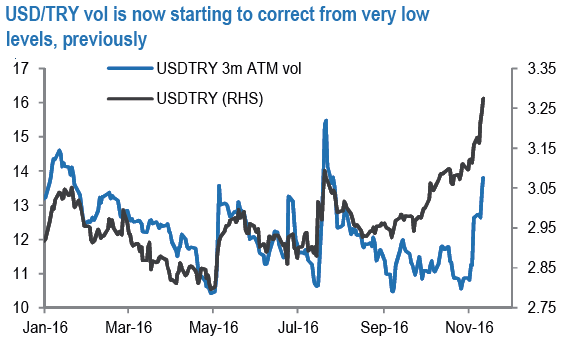
With the deterioration in the local political situation and a less supportive environment from higher G3 yields, the outlook for the lira is worsening, in our view.
We find option exposure most attractive at present, with implied volatility and skew trading near their lowest levels in a year when we entered our USDTRY call on 7th November. USDTRY vol has recently spiked higher following the global risk-off after the US election results, (see above chart).
Going forward, the absence of local FX selling in the coming weeks could render USDTRY a lot more volatile than the market has grown accustomed to, in our view.
The central bank has expressed concerns over the currency, suggesting it would not cut rates further without FX stability, but we doubt this is enough to stabilize the lira.
On the flip side, Fed’s rate hikes in December and easing cycle in 2017 is very much on the table.
While the CBRT could conduct FX sale auctions or release FX liquidity from its FX liabilities like it did last week, we think the impact of these measures would be modest, and so we do not expect the central bank to be particularly proactive with its toolkit to stabilize the lira in the interim, with dollar’s bullish signal from FxWirePro Strength Index (102), we could foresee the next higher levels of USDTRY to 3.40 levels and above.
As a result, we could also see that higher flashes in IVs of ATM contracts of USDTRY, 15.69% and 14.25% for 1m and 2m tenors respectively.
We recommend longs in ITM delta USDTRY call (3.25) of 06-Jan-17 expiry, at spot reference: 3.31.
Alternatively, risk averse could also enter into diagonal call spreads for cost effectiveness, it is advisable to go long in 1M (1%) OTM 0.36 delta call, while writing 1W (1%) ITM call with positive theta and delta closer to zero (both sides use European style options), this credit call spread option trading strategy is recommended when the underlying spot FX price is anticipated to drop moderately in the near term and spikes up in long term.







