


 Fed’s Logan Signals 50 Basis Points More in Rate Hikes
  European Stocks Rally on Chinese Growth and Mining Merger Speculation
  China’s Growth Faces Structural Challenges Amid Doubts Over Data
  Geopolitical Shocks That Could Reshape Financial Markets in 2025
  Fed’s Williams Sees One More Rate Hike in 2026, None in 2027
  Mexico's Undervalued Equity Market Offers Long-Term Investment Potential
  US Futures Rise as Investors Eye Earnings, Inflation Data, and Wildfire Impacts
  RBA Set for September Rate Hike as Inflation Stays High
  Lithium Market Poised for Recovery Amid Supply Cuts and Rising Demand
  BlackRock’s Rick Rieder Favors Bonds Over Stocks as Treasury Yields Surge
  RBI Raises Repo Rate to 5.50% in Hawkish Shift on Inflation Risks


 Add as a preferred source on Google
Brazil’s long-awaited exit from recession took a step back this week, with a disappointing set of August activity data leading us to lower the growth projection for Q3’16 even though we still see a tepid recovery starting this quarter. At the same time, COPOM began its easing cycle this week but did so with a less-than-expected 25bp cut and adopted a more hawkish tone in the post-meeting statement.
The committee conditioned the pace of future cuts on the implementation of fiscal measures and the behavior of cyclically sensitive services sector prices. As we do not foresee an immediate improvement on these fronts, we moved our November call to a25bp cut (from50bp).
However, we see an increase in the pace of cuts after Congress finalizes the approval of the spending cap bill and makes progress on pension reform. We now anticipate that the CB may cumulate 300bp easing by mid-2017.
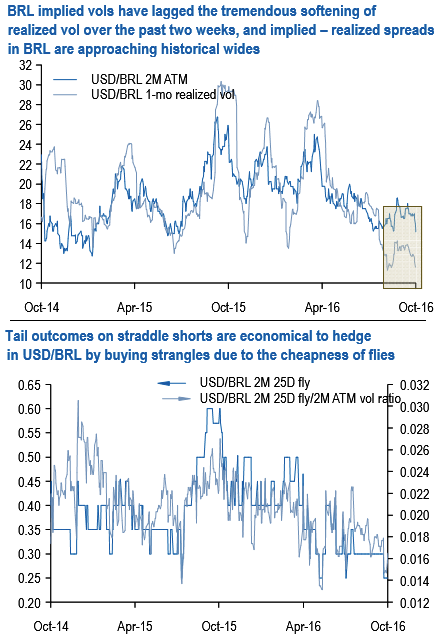
There are a few gamma shorts as convincing as BRL at present. USDBRL implied –realized vol spreads are stunningly wide (4w ATM – 4w hourly realized vol in excess of 7 % pts., 4.5 pts. if using close-to-close WMR measurements), and the leak lower in implied vols, even accounting for this week’s intense sell-off, has severely lagged the catastrophic decline in realized vol this month (see above chart).
The latter is due only in small part to the beta effect of the global compression in FX vol towards YTD lows; there is a larger, more important idiosyncratic component to the real narrative in that spot ranges have shrunk in the tug of war between attractive Brazilian real rates that have continued to fuel solid FDI and equity inflows and a still inexpensive currency, versus a considerably priced-in macro-recovery story, expectations of BCB rate cuts and still-extant fiscal uncertainty.
The new piece of information this week was that monetary easing that got underway this week is unlikely to derail the currency, judging by BRL’s positive response to a hawkish-sounding COPOM message (Hold BRL longs as the easing cycle kicked off with a ‘hawkish’ tone).
A slow grind lower in USDBRL towards 3.10 from here is likely to pressure front-end vols materially lower to reflect the exorbitant decay cost of owning options, and we sell delta-hedged 2M straddles to participate in the vol crunch.
For investors who would rather avoid the hassle of delta hedging and sell vol in management-lite capped loss format, we propose either (a) short straddle vs. long strangle spreads or (b) double no-touches. Both structures benefit from depressed levels of vol flies (see above chart) that render owning wings to eliminate tail losses of selling ATM vol an economical proposition.







