


 US Futures Rise as Investors Eye Earnings, Inflation Data, and Wildfire Impacts
  Fed’s Hammack Says Bond Yield Surge Is Not Driven by Inflation Fears
  BOJ Raises Interest Rate to 31-Year High as Yen Weakens
  Japanese Yen Retreats as Dollar Rises Ahead of Fed, BOJ Rate Decisions
  China's Refining Industry Faces Major Shakeup Amid Challenges
  Moody's Upgrades Argentina's Credit Rating Amid Economic Reforms
  Fed’s Logan Signals 50 Basis Points More in Rate Hikes
  Geopolitical Shocks That Could Reshape Financial Markets in 2025
  Standard Chartered Sees Ethena ENA Hitting $2 by 2028
  Yen in Focus as BOJ, Fed Rate Hikes Reshape Currency Markets
  NEAR Intents Hack Drains $3.8 Million, NEAR Price Falls 7.5%
  Bitcoin Short Squeeze Wipes Out $259 Million After U.S. PCE Data
  BlackRock’s Rick Rieder Favors Bonds Over Stocks as Treasury Yields Surge
  Hyperliquid Sets $856 Million HYPE Token Unlock for October


 Add as a preferred source on Google
We have been recommending shorts in GBP since early April as a core part of our overall defensive strategy. The bearish view has been motivated by multiple fundamental factors—ongoing Brexit ramifications, an already-large current account deficit and now a substantially larger fiscal deficit as well. Focus is now increasingly going to be on the possible extension of the transition period which under the terms of the Withdrawal Treaty has to be decided on by the end of June. The COVID-19 outbreak has resulted in obvious delays in the discussions and has had large economic ramifications, which is why our economists now think that a 1-year extension (to the end of 2021) has become increasingly likely (Brexit: the June flashpoint looms). While the EU is open to such an extension, recent news reports suggest that the UK government has pushed back against it.
The economists note that UK’s stance raises the odds that we enter July with no extension in place which would make for a messy outcome and at an extreme, could raise the possibility of a “no-deal”. Immediate attention will be on the May 11th second round of talks between UK-EU negotiations. The BoE next week will get some attention as well as we expect it to increase its QE programme by 50% or £100bn. This would take announced UK QE to a table-topping 13.5% of GDP. As set-out in the Outlook, GBP faces stiff headwinds from the combination of excessive QE, eye-popping fiscal issuance, and a large current account deficit.
Trade tips: Stay short in GBPUSD 1.227 levels via optionality, at the beginning of April. Marked at -2.06%.
The rationale: GBP will likely take its directional cue from the read-through to BoE’s rate cut whereas the size of the move will be augmented or moderated by the government’s broader policy platform, this is factored-in GBP’s FX options market.
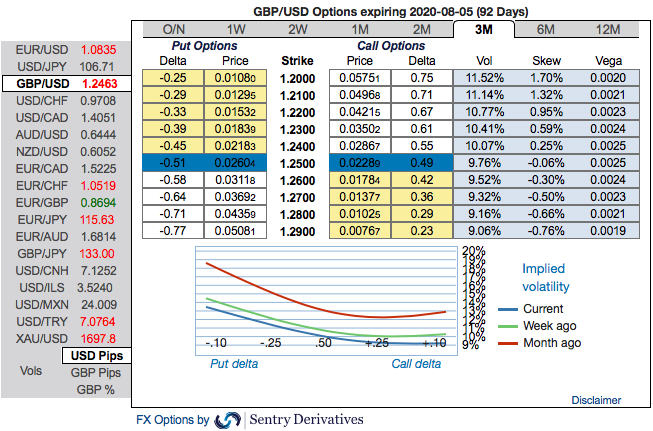
Please observe 3m GBP skews that has stretched towards negative territory, hedgers have shown interests for bearish risks as you could see more bids for OTM Put strikes up to 1.20.
To substantiate the downside risk sentiment, fresh bids in risk reversal numbers have still been signalling bearish hedging sentiments in the long run. Accordingly, we advocate the diagonal options strategy on both hedging and trading grounds.
Though the underlying spot FX is showing some resistance to the prevailing bearish streaks, these rallies seem to be momentary. Hence, this is right time to write deep OTM put options.
Execution of strategy (Debit Put Spread): Capitalizing on the above factors, it is prudent to deploy diagonal options strategy by adding short sterling via a limited loss tail hedge: Stay short a 1M/2W GBPUSD put spread (1.20/1.2850), spot reference: 1.2460 level.
Alternatively, activate shorts in GBPUSD futures contracts of May’20 deliveries with an objective of arresting potential slumps. Courtesy: JPM, Sentry & Saxo







