


 Cardano Price Surges 10% as ADA Targets $0.30
  ECB May Stop Rate Hikes After December, Capital Economics Says
  Sector Spotlight: Data Availability and Storage Lead 24-Hour Market Gains
  Circle Stock Falls 4% as Crypto Selloff Overshadows SAP Pay Expansion
  Ethereum Price Drops Below $2,600 as Long Liquidations Hit 4-Month High
  BOJ Signals Faster Rate Hikes as Inflation Risks Grow
  Fed’s Williams Signals One More Rate Hike Before Year-End
  Cardano Price Eyes $0.30 as ADA Whale Activity Surges
  Bitcoin Outflows From Binance Hit Three-Year High as Whales Accumulate
  BofA Raises Coinbase Stock Target to $203 on Stablecoin Growth
  Zcash Privacy Demand Rises as AI Exposes Bitcoin Transactions
  RBA Set for September Rate Hike as Inflation Stays High


 Add as a preferred source on Google
Following the attempted coup and the wave of purges by the Erdogan government, the Turkish economy slipped into recession. But according to official data, GDP jumped in Q4 by a hefty 3.9% in the quarter.
Monthly data releases paint a different picture. Falling tourism revenue, a widening trade deficit, a surge in the unemployment rate – this is not consistent with the GDP release.
Yet, it seems we have to base our forecast on official data. We see GDP growing at a rate of 3.3% this year.
On the back of the lira weakness, inflation rose to 11.3% in March, and the core rate came in at 9.5%. The real interest rate is thus still around zero. Inflation pressure should remain high this year.
A softer dollar, falling bond yields in developed markets and funding costs that are kept at relatively high levels in Turkey have stabilized the lira. Should this continue the central bank will likely start to lower average funding costs gradually. This should exert pressure on the TRY.
Hedging Framework:
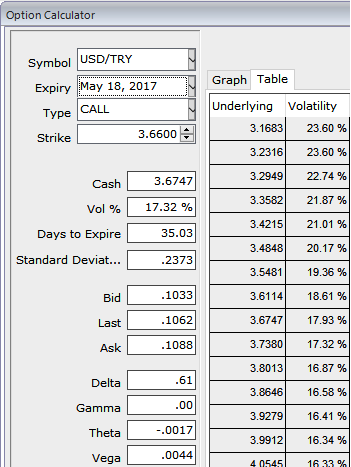
At spot reference: 3.6750, capitalizing on prevailing dips of this pair one can load up shorts in ITM calls and longs in either ATM or OTM calls in a credit call spread with a narrowed strikes of similar expiries.
While the major uptrend could be arrested by the longs of the underlying pair with longer tenors as the 1m ATM IVs are spiking above 17.32%.
So it is advisable to initiate Credit Call Spread (DCCS) in order to tackle both short-term dips and major uptrend.







